

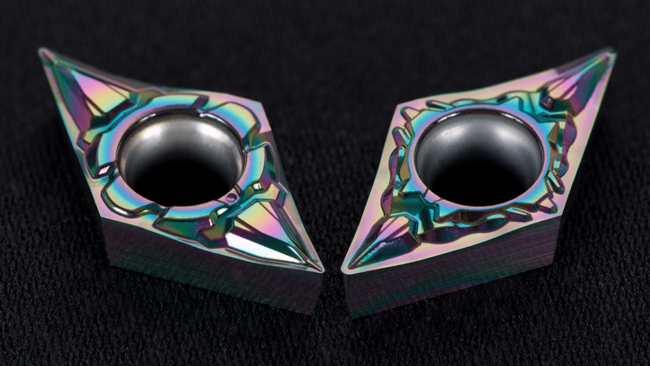
Tungaloy Corporation has announced the expansion of its DS2000 Series lineup, featuring DLC-coated grades designed for machining non-ferrous metals such as aluminum alloys.
The expanded range includes inserts with JS-type and JP-type chipbreakers, which offer chip control for precision machining and small-part machining, alongside the AL-type chipbreaker and threading inserts.
The DS2000 Series is a grade for machining non-ferrous metals that features Tungaloy’s proprietary DLC coating. With its excellent resistance to welding, the DS2000 Series suppresses the formation of built-up edges, while its high coating adhesion significantly reduces coating delamination. In addition, the coating’s high hardness and excellent heat resistance help slow the progression of cutting-edge wear, resulting in longer tool life. As a result, the DS2000 Series delivers stable machining performance in a wide range of non-ferrous metal applications, including aluminum alloys.
Challenges and Trends
In the field of small and precision parts machining involving non-ferrous metals such as aluminum alloys and copper alloys, the demand for higher accuracy and improved quality continues to grow. Users who machine small-diameter workpieces—such as valves, connectors, pump components, and semiconductor manufacturing equipment parts—on automatic lathes or compact CNC lathes constantly seek stable chip control and superior surface finish.
However, in actual production environments, many challenges specific to non-ferrous materials are often encountered, including long, continuous chips that wrap around the workpiece, built-up edge formation, and welding on the cutting edge that deteriorates surface roughness. Furthermore, uncoated carbide grades and conventional DLC coated grades have limitations in tool life and stability, making it difficult to fully support high-speed or mass production machining. As a result, there is a growing need for chipbreakers and grades optimized for small-part machining of non-ferrous metals.
Benefits and Features
Feature 1: JS and JP-type Chipbreakers Supporting High-Precision Machining
– The G-class 3D breaker design optimizes chip flow and ensures stable chip control.
– The unique protrusion geometry delivers excellent chip evacuation even under small depth of cut and low feed conditions.
– From finishing to precision finishing, it provides consistently superior surface quality in small-part machining.
Feature 2: First-Choice AL-type Chipbreaker for Non-Ferrous Metal Machining
– Achieves low cutting force with a large rake angle and sharp cutting edge.
– Provides excellent chip control through a large inclination angle cutting edge geometry and optimized chipbreaker design.
– Delivers superior resistance to built-up edge thanks to the combination of a mirror-finished rake face and DLC coating, enabling high-quality machined surface finishes.
Feature 3: Inserts with Finishing Edge for High-Precision Thread Machining
– The finishing-edge design compliant with ISO metric threads improves thread profile accuracy.
– Reduces adhesion, ensuring gloss and dimensional stability of thread surfaces.
– With stable tool life characteristics, it provides high reliability even in continuous production lines.