
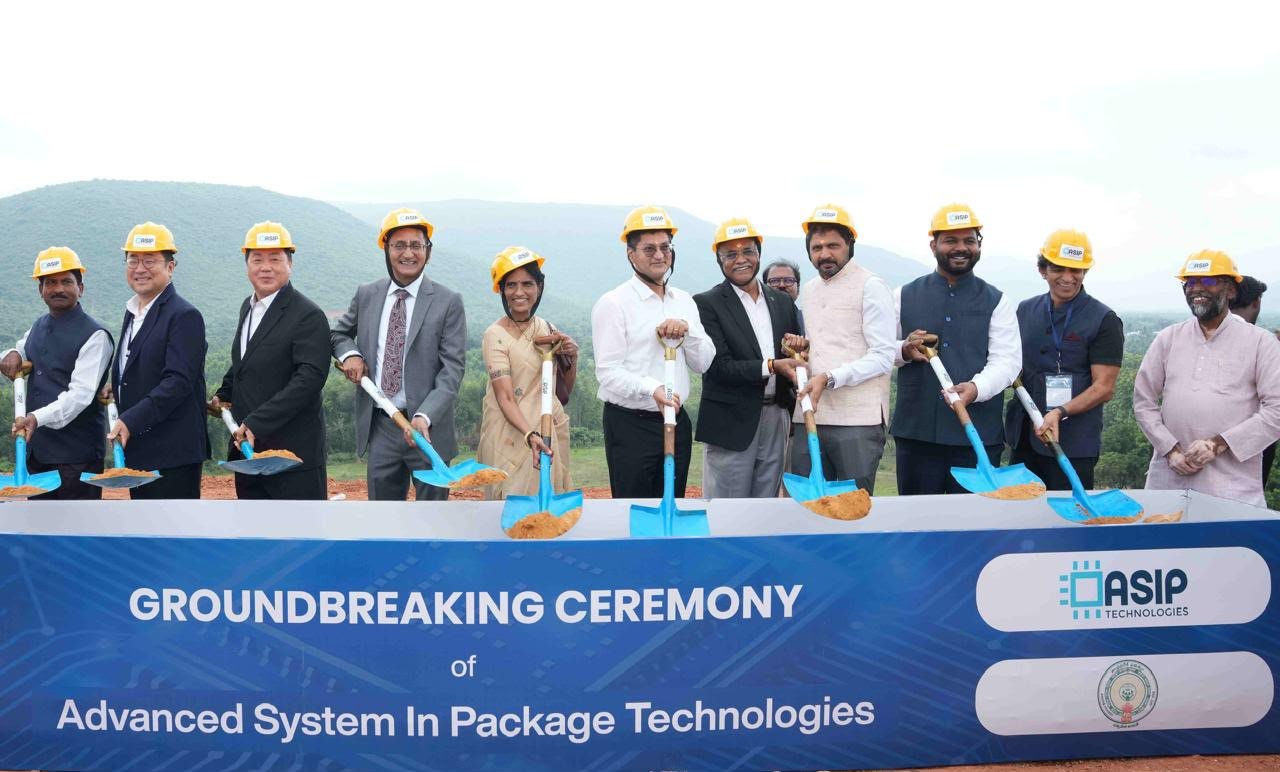
The ASIP semiconductor Visakhapatnam project has formally broken ground.
Prime Minister Narendra Modi virtually laid the foundation stone on August 1, 2026, for ASIP Technologies’ semiconductor manufacturing facility at Tarluvada, Visakhapatnam. On paper, it’s a ₹2,500 crore Outsourced Semiconductor Assembly and Test (OSAT) project, the first semiconductor manufacturing facility in Andhra Pradesh and South India to be approved under the India Semiconductor Mission. But look past the ceremony, and this groundbreaking says as much about India’s broader manufacturing trajectory as it does about chips.
The Announcement
Andhra Pradesh Chief Minister N. Chandrababu Naidu joined the Prime Minister virtually for the ceremony, alongside ISM CEO Amitesh Kumar Sinha, Andhra Pradesh IT & Electronics Secretary Bhaskar Katamneni, and a mix of industry leaders and global partners.
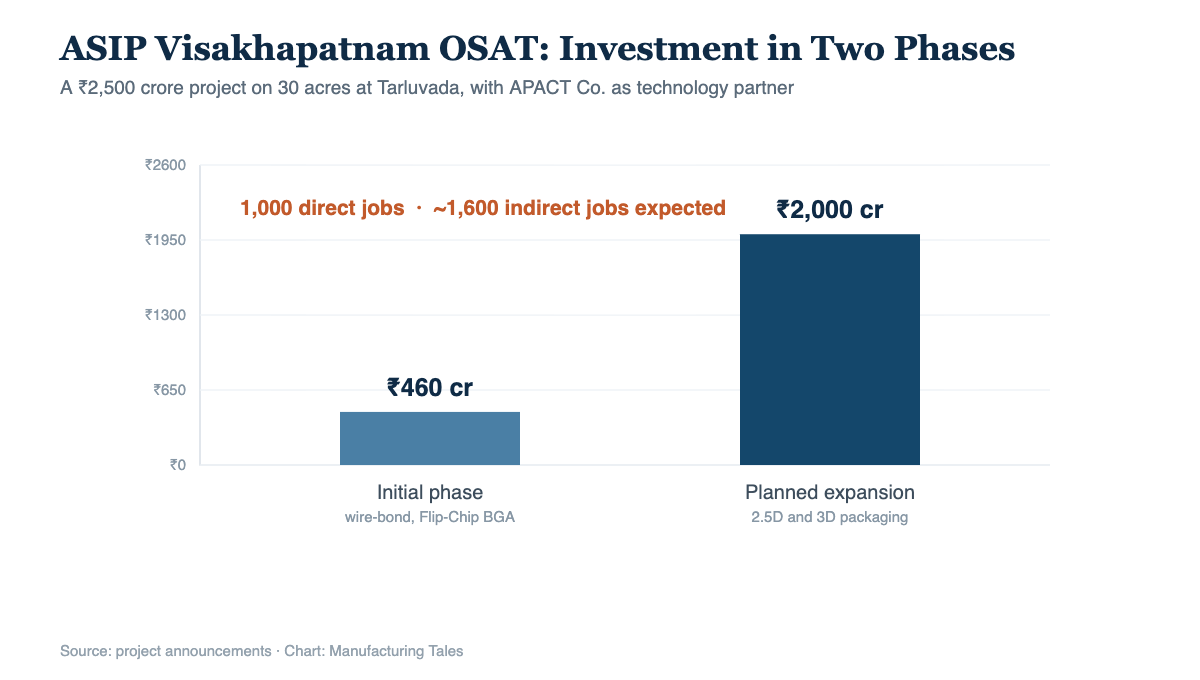
The 30-acre facility carries an initial investment of over ₹460 crore, built in partnership with South Korea’s APACT Co. as technology partner, with a planned annual capacity of 96 million chips aimed at AI, high-performance computing, data centres and high-speed communications. ASIP has already flagged a further expansion over ₹2,000 crore, to scale up advanced packaging operations, with more than 1,000 direct jobs and around 1,600 indirect jobs expected once the facility is running.
Production will begin with wire-bond and Flip-Chip BGA packaging, before ASIP introduces 2.5D and 3D packaging capabilities over the following two to three years.
Speaking at the event, the Prime Minister pointed to Andhra Pradesh’s existing strength in software talent as a natural launchpad into semiconductor manufacturing, framing the project as part of the broader Viksit Bharat push. ASIP’s Managing Director and CEO, Venkata Simhadri, called it a step toward strengthening India’s assembly, packaging and testing capabilities, while APACT’s CEO Seong Dong Lee described the tie-up as a blend of Korean technology expertise with Indian engineering talent, aimed at serving the wider global semiconductor ecosystem.
Why the ASIP Semiconductor Visakhapatnam Plant Matters Beyond the Chip
India today imports virtually every semiconductor chip used in its electronics industry. That single fact is worth sitting with, it means an enormous share of value in everything from smartphones to automobiles to industrial equipment is currently captured overseas before the finished product even reaches an Indian factory floor.
OSAT facilities like ASIP’s target a specific, often overlooked part of that value chain: packaging and testing, which typically account for roughly a third to nearly half of a chip’s total manufacturing cost. This isn’t the glamorous front end of chip fabrication, it’s the precision, quality-control-heavy back end. And that’s exactly why it matters so much to manufacturers who have nothing to do with electronics.
The Ripple Effect for Other Manufacturers
A facility like this doesn’t operate in isolation. Getting an OSAT plant to full capacity requires an entire supporting cast of suppliers and service providers, and that’s where the opportunity for India’s broader manufacturing base opens up.
Precision equipment and tooling suppliers stand to gain first. Semiconductor packaging demands cleanroom-grade tooling, specialised handling equipment, and calibration services work that machine shops and industrial equipment makers across South India could increasingly be pulled into, provided they can meet the exacting tolerances the sector demands.
Electronics and component manufacturers nearby benefit almost immediately. A domestic OSAT facility shortens the supply chain for companies further down the line device makers, PCB assemblers, and electronics manufacturing services (EMS) providers, who currently wait weeks for packaged chips to arrive from East Asia. Faster, more localised access to packaged semiconductors can meaningfully change production planning for these companies.
Construction, sustainability and infrastructure firms are already part of this story. The facility’s planned solar power generation and water recycling systems signal demand for green industrial infrastructure, an area where Indian sustainability-focused construction and engineering firms are increasingly competing for large industrial contracts.
Educational and training institutions are being pulled directly into the manufacturing conversation. ASIP’s plans to partner with IIT Tirupati and IIT Hyderabad, along with an in-house training centre, point to a deliberate strategy of building a local skilled workforce rather than relying on imported expertise. That approach tends to create spill over demand for technical training providers, equipment vendors serving educational labs, and allied instrumentation companies across the region.
MSMEs in Andhra Pradesh’s industrial belt may see the least visible but potentially widest-reaching impact. As ASIP works to localise a significant share of its supply chain over the next three to five years, smaller regional manufacturers from component suppliers to logistics and packaging vendors have a real opening to plug into a global semiconductor supply chain, something that has historically been almost entirely closed to them.
A Familiar Pattern
This mirrors what’s playing out in India’s defence manufacturing sector, where a handful of marquee projects are steadily pulling a much larger base of MSMEs, precision engineers and component suppliers into higher-value, higher-precision work. Semiconductor packaging may be a different industry entirely, but the underlying dynamic is the same: a single large facility becomes an anchor point, and the real economic impact shows up in the dozens of smaller manufacturers who eventually orbit around it.
The Bigger Picture
It’s easy to read this announcement as a story about chips, where they’ll be packaged, how many jobs it creates, how much capital is involved. But for Indian manufacturing more broadly, the more interesting question is what it enables next: a domestic packaging and testing base that shortens supply chains for electronics makers, a trained technical workforce that didn’t exist regionally before, and an opening for MSMEs to work their way into one of the most demanding and valuable global supply chains there is.
The ₹2,500 crore figure will be the headline. The supplier ecosystem it builds around itself over the next few years is likely to be the more lasting story.