

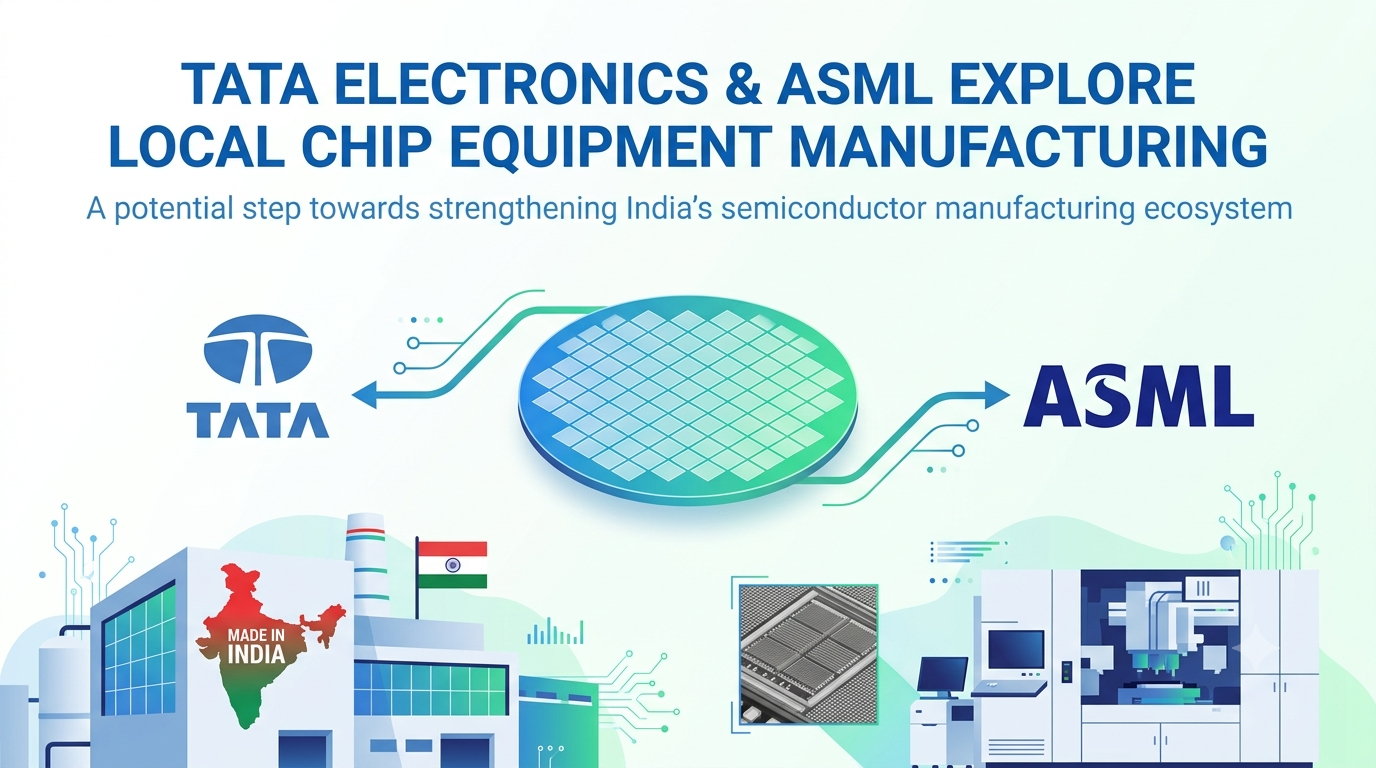
Tata Electronics is in early talks with ASML, the Dutch company that makes the machines nearly every advanced chip in the world passes through, about manufacturing components for that equipment right here in India. Nothing’s signed yet, this builds on an MoU from earlier this year, and to be clear, nobody’s talking about India building complete lithography systems. The initial focus is on more grounded stuff: structural frames, cable assemblies, connectors, circuit boards.
Still, it’s worth paying attention to.
Most of the conversation around India’s semiconductor push has centered on fabs, the giant plants where chips actually get made. That makes sense; they’re expensive, visible, and easy to turn into a headline. But fabs are only one piece of a much bigger picture. Behind every chip is a sprawling web of companies making the precision equipment, materials, and instruments that fabs depend on. The Tata-ASML conversation matters because it points toward that less glamorous, but arguably more foundational, layer of the industry.
India probably isn’t going to be building cutting-edge lithography machines anytime soon. But becoming a trusted supplier to the company that does? That’s its own kind of win.
Why ASML in particular
ASML isn’t just another equipment maker, its lithography systems are what let companies like TSMC, Samsung, and Intel produce their most advanced chips. Each machine is built from tens of thousands of highly engineered parts sourced from suppliers around the world, and the bar for those parts is brutal: precision, repeatability, consistency, no room for error.
So for an Indian manufacturer, the opportunity here isn’t really about the parts themselves. It’s about proving you can meet that bar at all, that Indian engineering firms can hold up under the scrutiny of one of the most demanding supply chains on earth. That reputation, once earned, travels.
The knock-on effects
If this actually turns into real manufacturing programs, the ripple effects wouldn’t stay contained to semiconductors. Think precision CNC machining, high-end tooling, metrology, surface finishing, cleanroom manufacturing, automation systems — capabilities that already exist to some degree in India’s automotive and aerospace sectors, just not yet tuned to semiconductor-grade tolerances. Companies that can hit that benchmark tend to become competitive well beyond electronics.
There’s also a broader strategic shift buried in this. For years, Indian industrial policy has been about luring in production facilities get the factory built, get the jobs, get the announcement. This is a different game: building the supplier base, the engineering talent, the quality systems that let a country participate in complex manufacturing rather than just host it. Countries don’t become manufacturing powerhouses by building one big final product, they get there by building the ecosystem underneath it. That’s a slower story, but a more durable one.
The Ripple Effect
If these discussions translate into manufacturing programmes, the benefits could extend across:
- Precision engineering companies
- Machine tool manufacturers
- Tooling and die & mould companies
- Industrial metrology providers
- Automation integrators
- Electronics manufacturing services
- Advanced materials suppliers
- Testing and certification laboratories
- Industrial software and digital manufacturing providers
- High-skilled engineering talent
The ripple effect is likely to be much broader than semiconductor manufacturing itself.
Beyond The Headline
The interesting question isn’t whether India ever builds an ASML machine. It’s whether Indian companies can become suppliers this industry actually trusts. If they can, the payoff isn’t limited to electronics, it shows up in precision engineering firms, tooling and die makers, metrology providers, automation integrators, materials suppliers, testing labs, and the engineers trained to work at that level.
These talks are still early, and there’s no guarantee they turn into anything concrete. But even at this stage, they say something about where India’s semiconductor ambitions are actually headed, less about the fabs that make the headlines, and more about quietly becoming part of the infrastructure that makes advanced manufacturing possible everywhere else.