
Indian manufacturers air freight volumes have risen sharply in recent weeks.
Mumbai, India – Indian manufacturers across the electronics and automotive sectors are increasingly shifting critical component shipments from sea to air freight, as disruptions linked to the ongoing West Asia crisis slow ocean shipping routes and threaten festive-season production schedules.
Companies are importing semiconductor chips, printed circuit boards, memory components and other time-sensitive parts by air after ocean shipments faced delays running into several weeks, according to industry reports. The shift comes despite air freight costing three to five times more than ocean shipping, with rates on both modes having risen sharply since the crisis began.
What the Indian Manufacturers Air Freight Shift Looks Like in Numbers
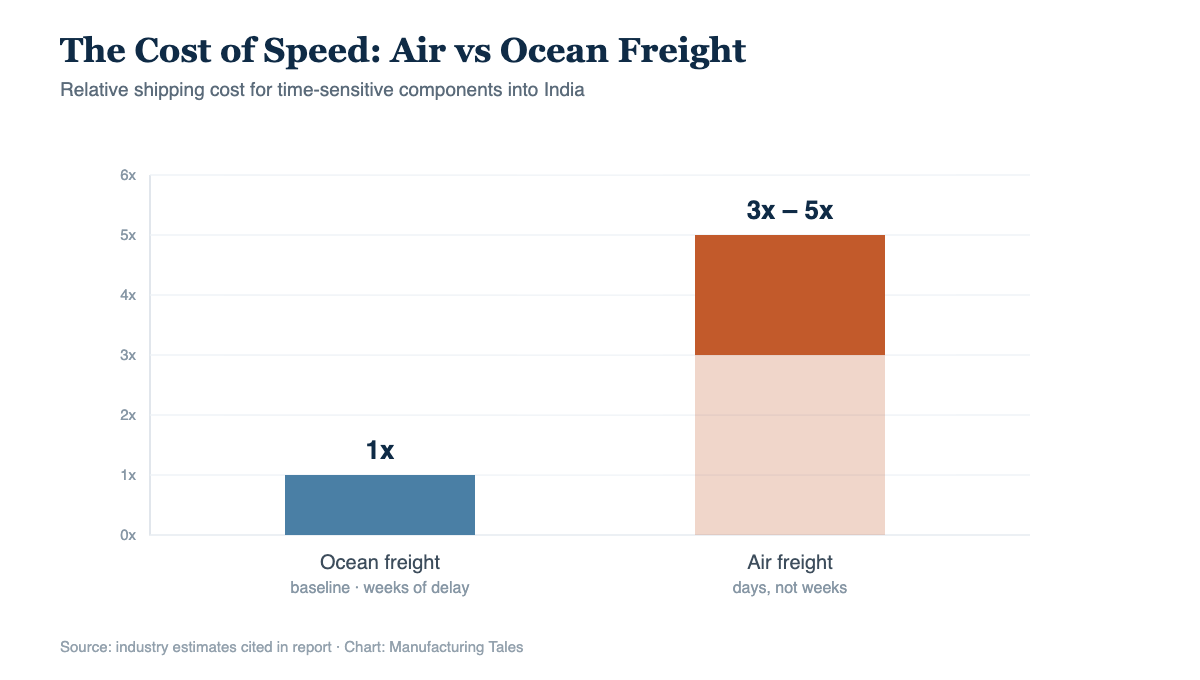
Industry data indicates that manufacturers are increasingly prioritising delivery certainty over cost efficiency, a departure from the cost-optimisation principles that have historically governed supply-chain decisions in Indian manufacturing.
The rationale is straightforward: when a relatively low-cost component gets held up at sea, the resulting production line stoppage can carry an economic cost far higher than the price difference between air and ocean freight. For manufacturers working against festive-season deadlines, that calculation is increasingly favouring speed over savings.
Several companies have already raised product prices this year in response to higher commodity and shipping costs. Industry sources indicate there is limited room to pass the additional air-freight burden directly on to consumers, meaning manufacturers are absorbing a portion of the added cost themselves to protect demand and keep production on schedule.
Industry Context: From Lean to Resilient
The disruption is prompting a broader reassessment of the just-in-time inventory model that has underpinned lean manufacturing for decades. Just-in-time systems, which minimise inventory and closely synchronise deliveries with production schedules, deliver strong efficiency gains under predictable conditions but leave limited buffer when a critical supply link is disrupted.
Manufacturing analysts do not expect a wholesale return to high-inventory models. Instead, the emerging response is expected to be more targeted: additional buffer stock for select critical components, greater investment in alternate supplier relationships, and diversified transport routing built into production planning rather than treated as a contingency measure after the fact.
Sectors considered most exposed to this kind of disruption include electronics, automotive, aerospace and industrial equipment, industries where a single missing component can halt an entire production line.
Why It Matters for India’s Manufacturing Position
The development comes at a time when India is positioning itself as a larger node in global manufacturing supply chains, spanning electronics assembly, automotive components, semiconductor packaging and defence production.
Industry observers note that global customers evaluating Indian suppliers increasingly weigh delivery reliability alongside cost and quality. A manufacturer able to guarantee consistent, on-time delivery even at a modest cost premium, may be viewed as a more dependable long-term partner than a lower-cost supplier prone to disruption-driven delays.
This reframes logistics resilience as a competitive manufacturing capability in its own right, rather than a purely operational or cost-management function.
Expected Ripple Effects
Industry watchers expect the current disruption to accelerate several structural shifts across Indian manufacturing over the coming quarters:
- Increased adoption of dual sourcing and regional supplier diversification, reducing dependence on single shipping corridors
- Logistics providers developing more flexible multimodal offerings, combining road, air and sea transport to reduce single-point failure risk
- Manufacturers reassessing inventory buffers specifically for high-risk, high-criticality components
- Procurement, warehousing and production planning functions becoming more tightly integrated with logistics strategy
- Potential downstream effects on product pricing, as companies weigh how much of the added freight cost can be absorbed versus passed on
Outlook
Industry sources indicate the current pattern reflects a broader recalibration already underway across Indian manufacturing: supply-chain resilience is increasingly being treated not as a logistics-department concern, but as a core element of manufacturing strategy, factored into decisions on sourcing, inventory, production planning and even pricing from the outset, rather than addressed only when disruptions occur.
Whether the West Asia-linked disruptions ease in the near term or persist through the festive season, manufacturers and analysts expect the shift toward diversified, resilience-first supply-chain planning to outlast the immediate crisis.