
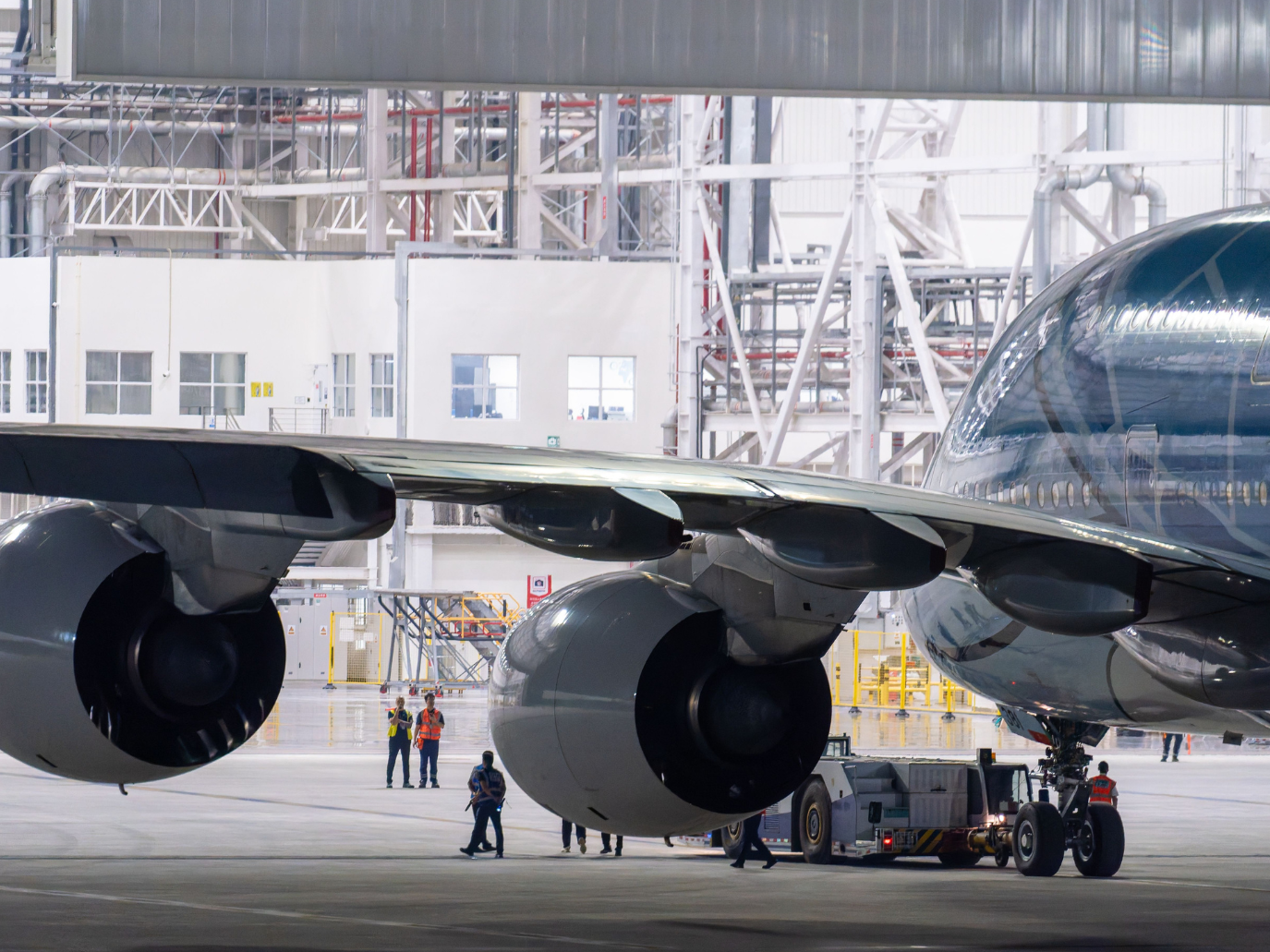
India is one of the fastest-growing aviation markets in the world, with new routes, new airports, new airlines placing enormous orders almost every year. And yet, most of the aircraft actually flying that growth continue to come from outside the country. At the same time, India has already proven it can build genuinely complex aerospace hardware structures, components, and sub-assemblies for some of the biggest aircraft manufacturers on earth.
So the interesting question isn’t whether India can manufacture aerospace parts. That’s already been answered. The real question is different: can India move from manufacturing parts of aircraft to manufacturing aircraft as finished products?
Mahindra’s recent move to set up Novavayu Aerospace is worth paying attention to precisely because it gestures toward that transition. It’s worth being careful here, though Novavayu hasn’t publicly committed to a specific aircraft programme yet, and it would be premature to treat this as India’s Boeing moment. What makes it genuinely interesting is timing, not ambition. It’s arriving at the precisely perfect point when several other pieces of India’s aviation ecosystem are showing up at roughly the same time.
Why This Is Happening Now
Individually, none of the recent developments in Indian aviation looks promising enough for a breakthrough. Together, they start to look like something closer to convergence.
The government’s Modified UDAN programme carries a ₹28,840 crore outlay running through FY2035-36, aimed at connecting underserved regions, developing around 100 airports, and notably supporting indigenous aviation capacity rather than just subsidising routes. Separately, Embraer and Adani Defence & Aerospace have been exploring an integrated regional aircraft ecosystem built around the E175, spanning final assembly, supply chain development, aftermarket services and pilot training. The government has also started talking more explicitly about India’s ambitions moving beyond military and transport aircraft into civil aircraft manufacturing. On the supplier side, companies like Lohia Aerospace are already investing in large-format 3D composite tooling, precisely the kind of specialised, capital-intensive capability a real aircraft ecosystem eventually needs. And on the demand side, ATR has pointed to substantial long-term demand for turboprop aircraft in India, while also flagging supply-chain constraints as a genuine limiting factor.
None of these, on their own, adds up to an aircraft industry. But policy, demand signals, industrial partnerships and supplier investment rarely align this closely by accident.
An Assembly Line Is Not an Aircraft Industry
This is the point where optimism needs a reality check. Setting up an assembly line is achievable in a relatively short window. Building an actual aircraft industry, one that owns engineering knowledge, supplier depth, and intellectual property, takes considerably much longer, and the two are easy to confuse.
An assembly operation can involve meaningful local labour and still depend almost entirely on imported engines, avionics, flight-control systems, landing gear, specialised materials and critical electronics. Which means the metric that actually matters isn’t “how many aircraft get assembled in India.” It’s how much of the aircraft’s engineering, manufacturing and supplier value is genuinely created here. Local assembly measures where an aircraft is put together. Local capability measures how much of the aircraft India actually knows how to make.
The Missing Layer: A Supplier Ecosystem
No aircraft manufacturer builds everything in-house, not Boeing, not Airbus, not Embraer. They rely on a deep chain of Tier-1 suppliers, Tier-2 precision manufacturers, and specialised MSMEs feeding components, sub-assemblies and systems into a final product. This is where India’s existing manufacturing strength genuinely matters, because the capabilities required CNC machining, sheet-metal forming, composites, casting and forging, aerospace fasteners, tooling and fixtures, wiring harnesses, sensors, metrology, surface treatment, MRO already exist in India in various forms, just not yet stitched together around a domestic aircraft programme.
So the more useful question isn’t just what Mahindra might eventually manufacture. It’s how many Indian precision engineering companies could become qualified aerospace suppliers simply because a real aircraft programme now exists to build toward.
Demand Is the Real Catalyst
An aircraft programme cannot survive on occasional orders. It needs repeatable, predictable demand large enough to justify local tooling and supplier investment, and this is exactly where India’s regional aviation push becomes strategically important, arguably more so than any single manufacturing announcement.
If Modified UDAN succeeds in creating durable demand for regional aircraft, trainers, utility platforms or specialised civil aircraft, Indian manufacturers gain something they’ve historically lacked: a domestic launch market. Without predictable demand, localisation stays expensive and marginal. With it, localisation starts to become commercially rational suppliers can justify investing in certification and tooling because they can see years of orders ahead of them, not just a single contract.
Certification: The Problem That Separates Aerospace From Everything Else
Precision components, structures, even full assembly lines, India has already shown it can build these. What it hasn’t yet built at scale is the institutional muscle around aircraft certification: demonstrating airworthiness, structural integrity, system safety, traceability and repeatable lifecycle performance. This is a large part of why aircraft manufacturing takes years, not quarters, to mature in any country. Certification capability has to grow in parallel with manufacturing capability, it can’t simply be bolted on once the factory exists.
What Actually Needs to Happen
Five things will likely determine whether India’s aircraft ambitions become real rather than aspirational: anchor demand from airlines, defence operators and connectivity programmes; sustained supplier development, backed by financing and certification support for Tier-2 and Tier-3 companies; credible, faster domestic certification infrastructure; a genuine move toward technology and IP ownership rather than assembly alone; and policy support structured around programme timelines measured in years, not election or budget cycles.
From Supplier Nation to Product Nation
India has already earned a reputation as a serious aerospace component and engineering destination. The next step is considerably harder: becoming a product owner. That means moving from manufacturing a fuselage section, a machined bracket, or a wiring harness, to developing the aircraft itself, with the engineering IP, certification knowledge and aftermarket revenue that come with owning the product, not just supplying into it.
India doesn’t need to replicate Boeing or Airbus overnight, and pretending otherwise would undercut the credibility of the whole story. What it needs is one successful aircraft programme, a regional aircraft, a trainer, a utility platform, that proves the model works. That programme creates suppliers. Those suppliers gain the capability and confidence to support the next programme. And gradually, deliberately, the country shifts from assembling aircraft in India to actually developing them here.
Mahindra’s move into aircraft manufacturing matters less as a standalone announcement and more as a marker of timing arriving just as demand, policy, capital, suppliers and partnerships are finally beginning to show up in the same place at once. India isn’t there yet, and it would be dishonest to claim otherwise. But the pieces are, for the first time in a while, starting to appear in the same room. The real work now is connecting them.