
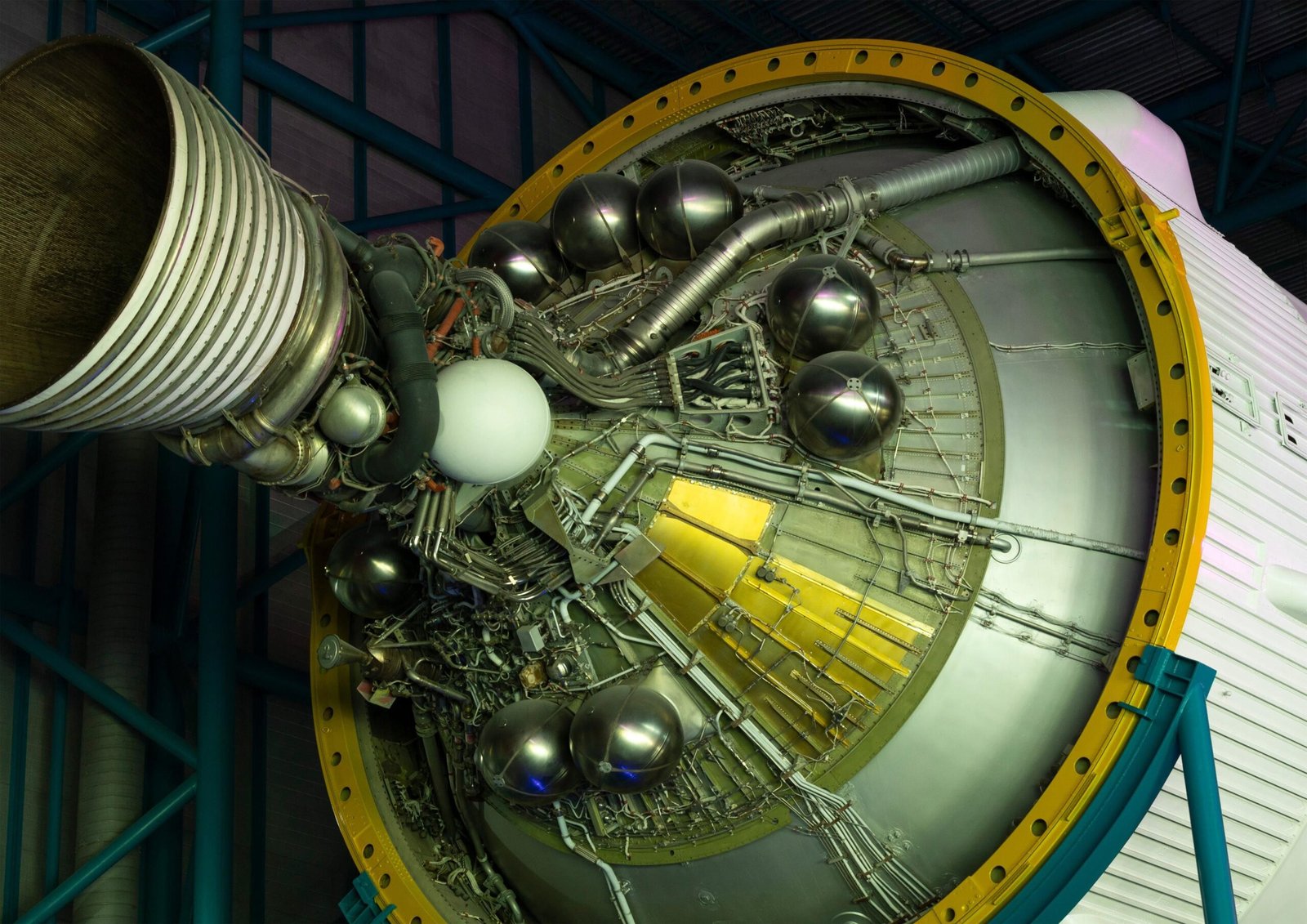
The Astrobase EVEREST engine is a production engineering story as much as a space one.
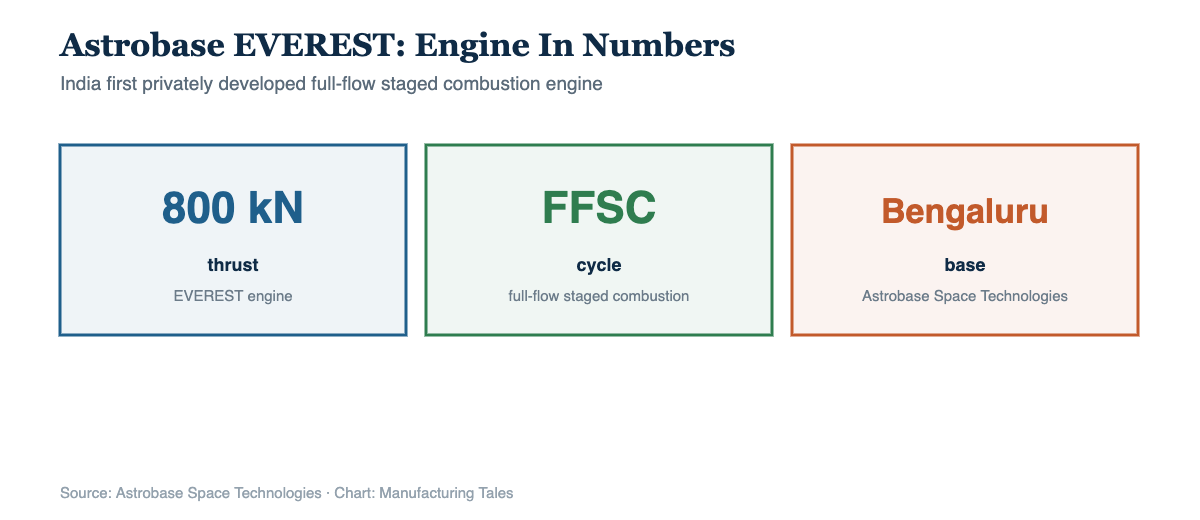
Bengaluru-based Astrobase Space Technologies has unveiled EVEREST, an 800 kN Full-Flow Staged Combustion (FFSC) rocket engine the company describes as India’s first privately developed engine of its kind. Astrobase is targeting the first orbital flight of its reusable launch vehicle by December 2028, with plans to scale manufacturing to as many as 50 EVEREST engines a year once its facilities are fully operational.
It’s tempting to read this as a space story. It’s worth reading it as a manufacturing story instead because what Astrobase is attempting is arguably one of the hardest precision-engineering problems humans have solved, and they’re trying to build it at scale, domestically, from day one.
What The Astrobase EVEREST Engine Does
Why This Engine Matters
Not all rocket engines are equal. Conventional engines dump some unburned propellant as exhaust after driving the turbopumps, which waste engineers have historically tolerated for simplicity. An FFSC engine eliminates that almost entirely, fully gasifying both fuel and oxidiser through separate pre-burners before the main combustion chamber, enabling pressures beyond 300 bar and meaningfully higher efficiency.
That efficiency comes at a steep engineering cost, which is why so few organisations have attempted it. Astronaut Shubhanshu Shukla, present at the unveiling, called FFSC one of rocketry’s most challenging architectures, SpaceX’s Raptor is currently the only such engine to have flown to orbit. If Astrobase succeeds, India becomes only the third country after the US and China to fly one, a remarkably ambitious target for a company founded in 2024.
The Manufacturing Story Behind the Rocket
Astrobase’s 46,000 sq. ft. Bengaluru facility houses what’s reported to be India’s largest industrial metal 3D printer, built specifically to manufacture EVEREST at scale, with a goal of hot-firing roughly one engine a week at full capacity. The company plans to manufacture and test around 20 engines before its first orbital attempt, a qualification pathway that signals commitment to repeatability, not a single headline launch.
Building one prototype and building fifty reliable, flight-qualified engines a year are entirely different problems. The first is an engineering achievement; the second is an industrial one, demanding consistent metallurgy, repeatable additive manufacturing, and robust testing infrastructure. Astrobase calling its ambition a “vertically integrated launch ecosystem” suggests it understands exactly which problem it’s solving for.
Manufacturing Insight
Rocket engines sit at the extreme end of precision manufacturing, which is what makes domestic engine-building capability valuable well beyond space. EVEREST demands aerospace-grade alloys built for extreme thermal and pressure loads, additive manufacturing precise enough for complex internal geometries traditional machining can’t replicate, and turbomachinery toleranced in microns.
None of this stays confined to one company. Capabilities built to manufacture an FFSC engine reliably, advanced metal 3D printing, high-pressure combustion testing, and cryogenic propellant handling carry directly into aerospace, defence, energy and industrial equipment. It’s the same pattern seen in India’s defence and semiconductor manufacturing pushes: one demanding programme forces capability that strengthens the broader industrial base long after its own headlines fade.
Good Timing
Astrobase is entering a genuinely active moment for Indian private space. Skyroot Aerospace completed its first orbital launch this year; Agnikul Cosmos is targeting one later this year. Most Indian players have focused on the small-launch “cab-to-space” niche, a smart strategy for a young industry. Astrobase’s medium-lift, reusable, FFSC-powered approach is a deliberate step into a far more demanding tier, backed by IN-SPACe’s Technology Adoption Fund, a sign India’s space ecosystem is willing to back genuinely hard bets, not just incremental ones.
The Ripple Effect
If Astrobase scales as planned, the impact could extend well beyond one engine. Advanced 3D printing suppliers gain a serious anchor customer for a still-nascent Indian capability. Precision machining and turbomachinery specialists get pushed toward tolerances few domestic customers currently demand. Cryogenic and high-pressure testing providers find a market that could serve multiple space-tech firms, not just one. Materials science and metallurgy researchers get commercial motivation to accelerate next-generation aerospace alloys. And India’s wider private space ecosystem benefits regardless of company affiliation, a domestic FFSC success validates that Indian space-tech can compete at rocketry’s hardest tier, likely drawing further investment sector-wide.
The Bigger Picture
To be clear-eyed: EVEREST hasn’t been hot-fire tested yet, and Astrobase itself says these targets are still to be demonstrated. A genuinely difficult qualification pathway remains before any of this is proven rather than a roadmap.
That honesty is exactly what makes it worth rooting for. Astrobase isn’t claiming to have solved rocket propulsion; it’s methodically building toward one of the hardest engineering problems in the world, with repeatability and scale designed in from day one. If it works, the more important story by December 2028 may not be the rocket reaching orbit; it may be the fifty-engines-a-year manufacturing capability quietly built underneath it.