
The PM E-DRIVE scheme has been extended for electric two-wheelers. The Ministry of Heavy Industries has widened the electric two-wheeler pot to ₹2,767 Cr and pushed the terminal date out by 20 months, handing OEMs and the component base feeding them a longer runway.
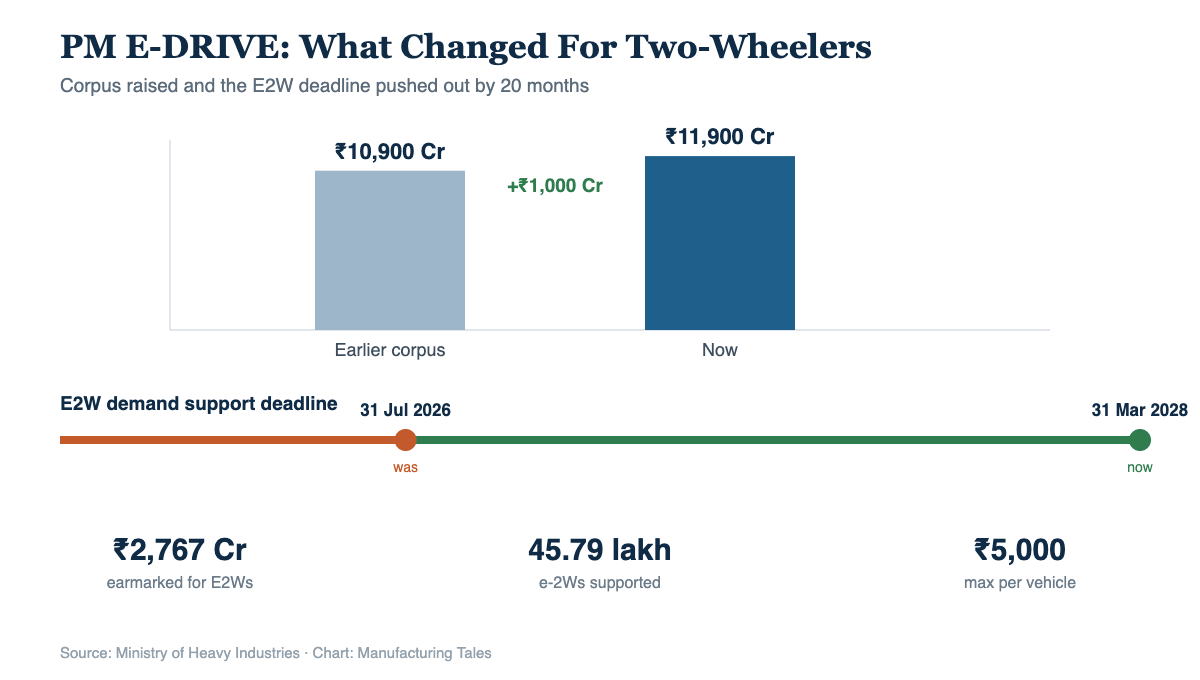
India’s electric two-wheeler industry just got a reprieve it had been quietly lobbying for. In a fresh notification, the Ministry of Heavy Industries (MHI) has raised the overall corpus of the PM Electric Drive Revolution in Innovative Vehicle Enhancement (PM E-DRIVE) scheme by ₹1,000 Cr, taking it to ₹11,900 Cr from the earlier ₹10,900 Cr. More importantly for anyone building two-wheelers or the parts that go into them, demand support for registered electric two-wheelers (E2Ws) now runs until March 31, 2028.
That last point matters. Under an earlier revision issued in late March 2026, the incentive tap for E2Ws was set to close on July 31, 2026, a cliff that would have landed squarely in the middle of the festive build-up. The new order removes that deadline and aligns the two-wheeler segment with the scheme’s broader 2028 horizon.
What The PM E-DRIVE Scheme Actually Changed
The headline number for the segment has moved twice over. The March notification had capped E2W support at 24.79 lakh vehicles and set aside ₹1,772 Cr for it. The latest amendment nearly doubles the volume ceiling to 45.79 lakh vehicles and lifts the allocation to ₹2,767 Cr.
The per-vehicle math, however, stays where the government had always signalled it would land. Buyers get ₹2,500 per kWh, capped at ₹5,000 a vehicle, on purchases made between April 1, 2025 and March 31, 2028. That is half the FY25 rate of ₹5,000 per kWh capped at ₹10,000.
Before anyone reads this as a fresh cut, it isn’t. The original PM E-DRIVE notification back in September 2024 had already spelt out that incentives would be halved from FY26, with the subsidy capped at 15% of a vehicle’s ex-factory price. Only E2Ws priced up to ₹1.5 lakh ex-factory qualify. So the tapering was baked in from day one. What’s new here is the extra time and the larger volume runway.
E-Rickshaws And E-Carts Hold Their Ground
The smaller three-wheeler segment carries forward the structure set in March. Up to 39,034 registered e-rickshaws and e-carts remain eligible, with ₹50 Cr earmarked. The incentive works out to ₹5,000 per kWh (capped at ₹25,000) for FY25, stepping down to ₹2,500 per kWh (capped at ₹12,500) from FY26. Eligible vehicles must sit under a ₹2.5 lakh ex-factory price, again with the 15% cap in play. Their terminal date, like the E2Ws, is March 31, 2028.
For the paperwork-minded: the last date to file claims under the scheme is December 31, 2027, and MHI has made clear that no payouts will flow after March 31, 2028.
Why The Manufacturing Side Should Care
PM E-DRIVE was never designed purely as a consumer sop. When it was notified in September 2024 with a ₹10,900 Cr outlay and a March 2026 sunset, the stated intent was threefold: accelerate EV uptake, build out charging infrastructure, and deepen the domestic EV manufacturing ecosystem. Beyond two- and three-wheelers, the scheme also underwrites electric ambulances, e-trucks, e-buses, charging networks and the upgrading of testing agencies. In June, MHI folded electric ambulances into the fold, committing ₹500 Cr for 3,811 units across FY27 and FY28.
For OEMs and, further upstream, the tooling, stamping, motor-lamination and battery-pack suppliers that live and die by production volumes, a predictable demand curve is worth more than a generous but short-lived one. The July cliff would have forced awkward inventory and capacity calls right before the busiest selling months. A clean line of sight to 2028, paired with headroom for another 21 lakh subsidised two-wheelers, gives planners something firmer to build against.
PM E-DRIVE sits in a lineage that runs through FAME-I, FAME-II and the Electric Mobility Promotion Scheme (EMPS) 2024, a decade of demand incentives that has slowly pushed the two-wheeler market toward electric. This extension is a recognition that the segment still isn’t standing entirely on its own feet. The subsidies aren’t ready to be pulled just yet, and for the factories feeding this transition, that’s the reassuring part.