
Rare earth magnets India policy just gained a heavyweight contender. The engineering major is lining up a bid for the government’s ₹7,280 Cr magnet incentive, a move that would pull one of the most China-dependent components in the EV bill of materials onto Indian soil.
Larsen & Toubro is preparing to step into rare-earth magnet manufacturing in India, according to people familiar with the plans. For a company that has built its name on construction, heavy engineering and large industrial projects, this is a notable pivot into high-precision component making, and it lands right in the middle of a supply-chain problem that has been keeping motor and EV makers up at night.
The immediate trigger is money. L&T is putting together a bid for the government’s ₹7,280 Cr (roughly $764 million) incentive scheme aimed at building a domestic rare-earth permanent magnet industry. The people cited in reports say the company will need to bring in a technology partner with genuine expertise, since magnet production is a demanding, high-precision discipline that India has almost no existing base in.
Rare Earth Magnets India: A Crowded Starting Grid
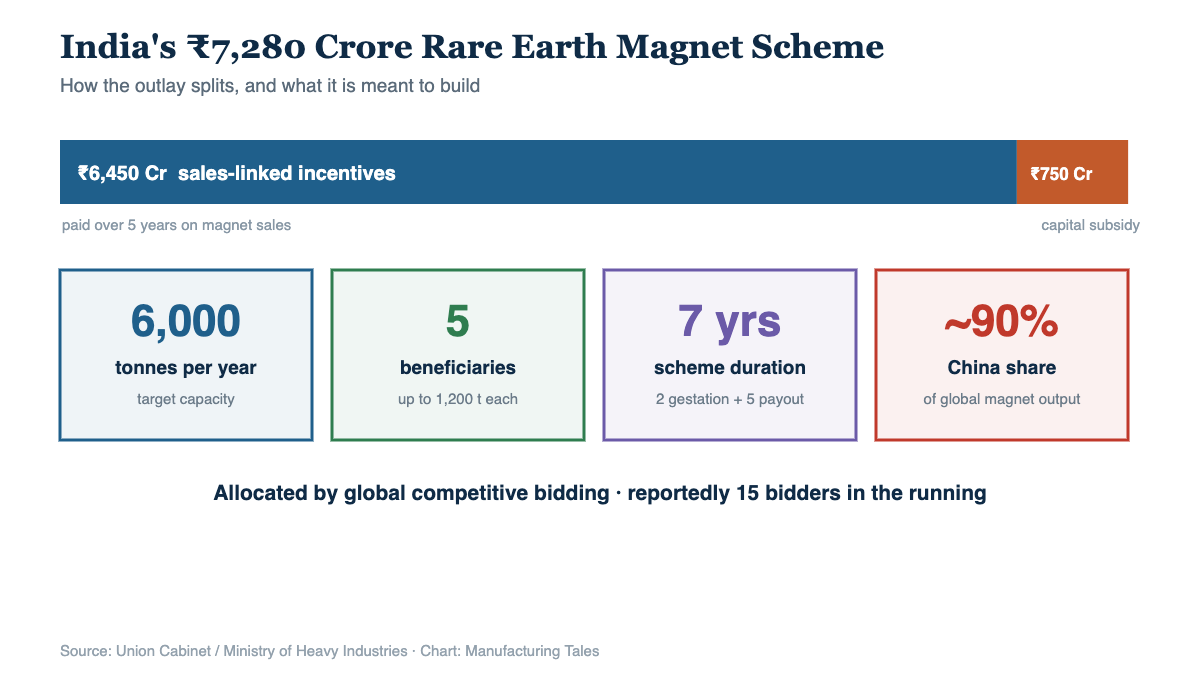
L&T is not alone in eyeing this. The programme has reportedly drawn 15 bids so far, one of them from a consortium pairing Japan’s Proterial Ltd. with two Indian automakers. That level of interest tells you how strategically important this component has become, and how much appetite there is to be among the handful of players the government eventually backs.
The structure of the scheme explains the pull. India approved a seven-year programme last year built around ₹6,450 Cr in sales-linked incentives and ₹750 Cr in capital subsidies. The stated target is 6,000 metric tonnes of annual domestic magnet capacity, with support flowing to roughly five companies. The design deliberately leaves room for both Indian firms and overseas magnet makers willing to set up local production.
Why The Scheme Exists: China
None of this is happening in a vacuum. China controls around 90% of global rare-earth magnet output, and in April last year it tightened exports of the component. For a country trying to scale up electric mobility, wind power, industrial robotics and a long list of electronics, all of which lean on these magnets, that kind of chokehold is a real vulnerability. The incentive policy is essentially India’s attempt to buy its way out of that dependence and stand up a supply chain of its own.
This is the China+1 conversation made concrete. It is one thing to talk about diversifying away from a single source of supply, and quite another to commit thousands of crores to manufacturing one of the harder components to make. Rare-earth magnets sit at exactly the point where geopolitical risk and precision manufacturing meet.
The Vertical-Integration Logic
For L&T specifically, the magnet play is not a standalone bet. It slots neatly into the company’s broader move into EV motors, which depend on rare-earth permanent magnets to begin with. Owning the magnet supply would give L&T a measure of control over its own motor programme rather than leaving it exposed to the same import risk it is trying to help the country escape.
That motor programme is already taking shape. L&T has tied up with Israel-based EVR Motors to build next-generation EV traction motors locally, a partnership it flagged on its earnings call last month. Its EPS Mobility unit has landed its first commercial order, a deal to supply 500,000 motors to an unnamed two-wheeler manufacturer over three years. Put the two together, magnets feeding motors feeding vehicles, and the strategic shape of the bet becomes clear.
An L&T spokesperson did not immediately respond to a request for comment on the magnet plans.
What To Watch
The bidding is still in play, and L&T’s entry does not guarantee an award. The technology-partner question is the real test: whoever cracks the process know-how and can hit precision and quality at scale will have a decisive edge. But the direction of travel is unmistakable. India is trying to move a critical, China-dominated component into domestic factories, and one of its biggest engineering names now wants to be part of that build-out. For the motor and EV supply chain, and for anyone tracking where India’s manufacturing ambitions are heading next, this is a thread worth following closely.