
India’s push to become a global manufacturing hub is not just about making more finished products. It is also about building the supply chains behind them, and solar is a strong example.
In its recent Report on Key Sectors to Position India as a Global Manufacturing Hub, NITI Aayog, in partnership with Crisil, highlights solar PV manufacturing as an important opportunity for India. The progress so far is significant. India’s solar module manufacturing capacity rose from around 2.3 GW in 2014 to about 100 GW by August 2025, while cell manufacturing capacity increased from below 1.2 GW to around 25 GW.
But the next opportunity may lie deeper in the value chain. With India targeting 280 GW of solar capacity by 2030, the demand for cells, wafers, materials, components and manufacturing technologies will continue to grow. The opportunity now is to turn solar demand into a deeper manufacturing ecosystem.
The Sprint That Already Happened
According to the GMH report, this growth has been driven almost entirely by policy, the Production Linked Incentive scheme, the Approved List of Models and Manufacturers (ALMM), and Basic Customs Duty on imported cells and modules. PLI alone carries a total outlay of roughly Rs 24,000 crore ($2.7 billion) and has been awarded across roughly 48 GW of integrated manufacturing capacity in two tranches.
Exports have followed the same trajectory: India’s PV exports in fiscal 2025 were eight times what they were in fiscal 2018. But that growth comes with a concentration risk: the United States alone accounted for 97% of India’s PV exports last fiscal year, leaving Indian manufacturers heavily exposed to a single market’s trade policy and tariff decisions.
The Gap Hiding Behind the Headline Number
Here’s where the “100 GW milestone” story gets more complicated. India’s manufacturing strength is almost entirely downstream modules and cells, while the upstream of the value chain, polysilicon and wafers, remains close to entirely import-dependent. Independent industry analysis backs this up in stark terms: India’s domestic polysilicon capacity stood at roughly 3.3 GW as of mid-2025, representing under 5% of what its module manufacturing capacity actually needs, meaning close to 95% of the polysilicon Indian manufacturers consume is imported, overwhelmingly from China (Wright Research).
The government has recognised this gap and is now moving to close it. A newly proposed PLI scheme specifically for polysilicon manufacturing is designed to address what one policy analysis calls a genuinely strategic vulnerability, since polysilicon disruption anywhere in the chain can stall the entire downstream industry regardless of how much module capacity India has built. Notably, high-purity polysilicon isn’t just a solar input; it’s also relevant to India’s semiconductor ambitions, which raises the strategic stakes of closing this gap beyond clean energy alone.
China, for context, still controls roughly 93–98% of global polysilicon production and about 91% of wafer capacity, meaning even India’s celebrated module success story is currently built, several layers back, on Chinese inputs.
PV manufacturing concentration across countries
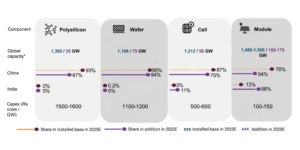
Source: IEA renewable energy outlook, Crisil Intelligence
The Ripple Effect
Solar is the one sector in this report where industrial policy and climate policy are explicitly the same bet. India’s 500 GW non-fossil capacity target and its manufacturing self-reliance ambitions rise or fall together; a polysilicon supply shock wouldn’t just be a trade story, it would directly threaten the pace of India’s own energy transition. That’s a different kind of ripple effect than the other sectors in this series: it links a manufacturing gap directly to a national climate commitment.
Manufacturing Insight
The direction of the next policy wave is already visible in the pipeline: expect PLI-style incentives, ALMM extensions, and possibly new customs duties to shift upstream toward polysilicon and wafer manufacturing over the next few years, rather than continuing to reward module and cell assembly, which is now comparatively mature. Companies and investors positioning early in integrated, polysilicon-to-module manufacturing rather than staying purely in downstream assembly are the ones best aligned with where both the report’s recommendations and the government’s actual policy direction are heading.