
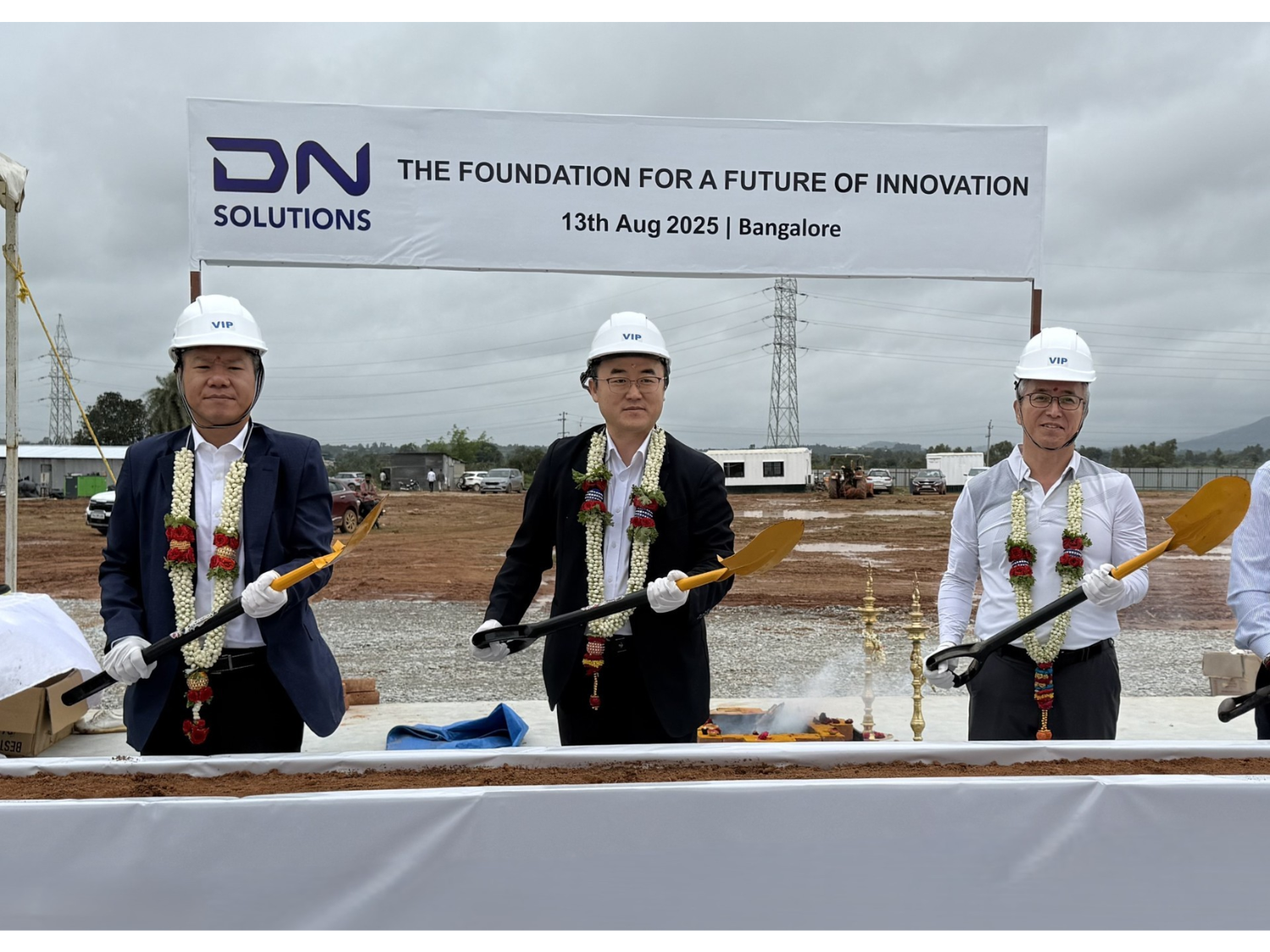
South Korean machine tool manufacturer DN Solutions has inaugurated its first manufacturing plant in India, a ₹600 crore facility at the Kundana General Industrial Area in Devanahalli taluk, near Bengaluru International Airport. Karnataka’s Large and Medium Industries Minister M.B. Patil opened the facility, noting that the agreement with DN Solutions was actually signed two years earlier, during his own visit to Seoul in July 2024. “It is a significant achievement that the manufacturing and R&D facilities have been completed within such a short period,” Patil said.
That detail is worth sitting with before getting to the rest of the story: this week’s opening isn’t a sudden new commitment, it’s the delivery on a two-year-old MoU, and DN Solutions itself has operated in India for over three decades, beginning sales in 1994, opening a Bengaluru technical centre in 2008, and establishing its Indian subsidiary in 2016. The plant opening is a genuine milestone, but it’s the natural next step in a long relationship, not the arrival of a new entrant testing the Indian market for the first time.
What’s Actually New Here
The 25-acre facility combines manufacturing, R&D, a technical centre and after-sales service under one roof, developed with the Karnataka Industrial Areas Development Board (KIADB). It will initially produce SVM series vertical machining centres and LYNX and LEO series horizontal turning centres, with five-axis machine production planned for later phases. DN Solutions says it has fully deployed its Phase 1 investment and is “considering further investments of a similar scale, subject to market demand and business growth” worth noting because it means the ₹600 crore figure represents what’s been committed so far, not a ceiling on the company’s India ambitions.
Importantly, DN Solutions has stated this is a new production investment, not a relocation of existing manufacturing from Korea or China, a distinction that matters given how often “new plant” announcements in manufacturing actually represent capacity shifting from one location to another rather than genuinely additive investment.
Why Karnataka, Specifically
Patil’s remarks at the inauguration included a statistic worth grounding the location decision in: Karnataka accounts for 52% of India’s total machine-tool production. That’s not a marginal factor, it’s close to a majority of the entire domestic industry concentrated in one state, which makes Bengaluru’s choice look less like a generic “attractive investment destination” pitch and more like a company locating directly inside its most relevant existing industrial cluster.
Patil also announced plans for a dedicated industrial park for Korean companies, modelled on the existing Japan Tools Industrial Park near Tumakuru, an established cluster the minister described as successful. That’s a meaningfully bigger signal than DN Solutions’ plant alone: Karnataka appears to be trying to replicate a proven cluster-development template specifically for Korean manufacturers, rather than treating this single investment as a standalone win.
The Localisation Numbers, Verified
DN Solutions says localisation has reached approximately 80% by parts count, with plans to source most components from India over the next five years, excluding spindle assemblies consistent with the original reporting. A formal supplier development programme is planned for 2027. The company is explicitly pursuing this by developing new Indian suppliers and MSMEs, rather than simply relocating its existing Korean or Chinese supplier relationships into India, a meaningful distinction, since the latter approach would create far less genuine domestic industrial depth than the former.
On employment, the company currently employs 240 people directly in India and aims to reach 500. Over the past year it has recruited around 100 recent graduates and operates its own training centre alongside a one-year talent development programme concrete, verifiable evidence of the skills ecosystem argument, rather than the more abstract “advanced manufacturing requires investment in people” framing common to this kind of story.
The Import Numbers That Make This Matter
India’s dependence on imported machine tools is not a vague claim — it’s a specific, sizeable figure. India imported machine tools worth more than ₹40,000 crore in FY2023-24, up from around ₹35,460 crore the previous year, according to Statista data cited by Deccan Herald. Union Minister for Heavy Industries and Steel H.D. Kumaraswamy has pointed to the National Capital Goods Policy 2025 as the government’s framework for reducing that import reliance, while Karnataka’s own minister has projected India’s machine-tool industry could generate $3.8 billion in revenue by 2030, driven largely by the metal-cutting segment DN Solutions operates in.
Set against that backdrop, DN Solutions’ localisation commitment reads as more consequential than a single company’s supply-chain decision, it’s a data point inside a government policy push specifically targeting the exact import-dependence figure this investment is chipping away at.
The Bigger Picture
The two-year gap between DN Solutions’ original MoU and this week’s opening is a useful reminder for how to read manufacturing investment announcements generally: the press release moment (MoU signing) and the operational moment (plant inauguration) are genuinely different milestones, often separated by years of construction, hiring and supplier qualification that happen with far less coverage than either bookend gets. The more interesting test of this investment’s real impact won’t be visible this week, it will show up over the next five years, as the formal 2027 supplier development programme either does or doesn’t convert Karnataka’s existing machining and precision engineering base into qualified suppliers for a global machine-tool manufacturer’s local production line.