
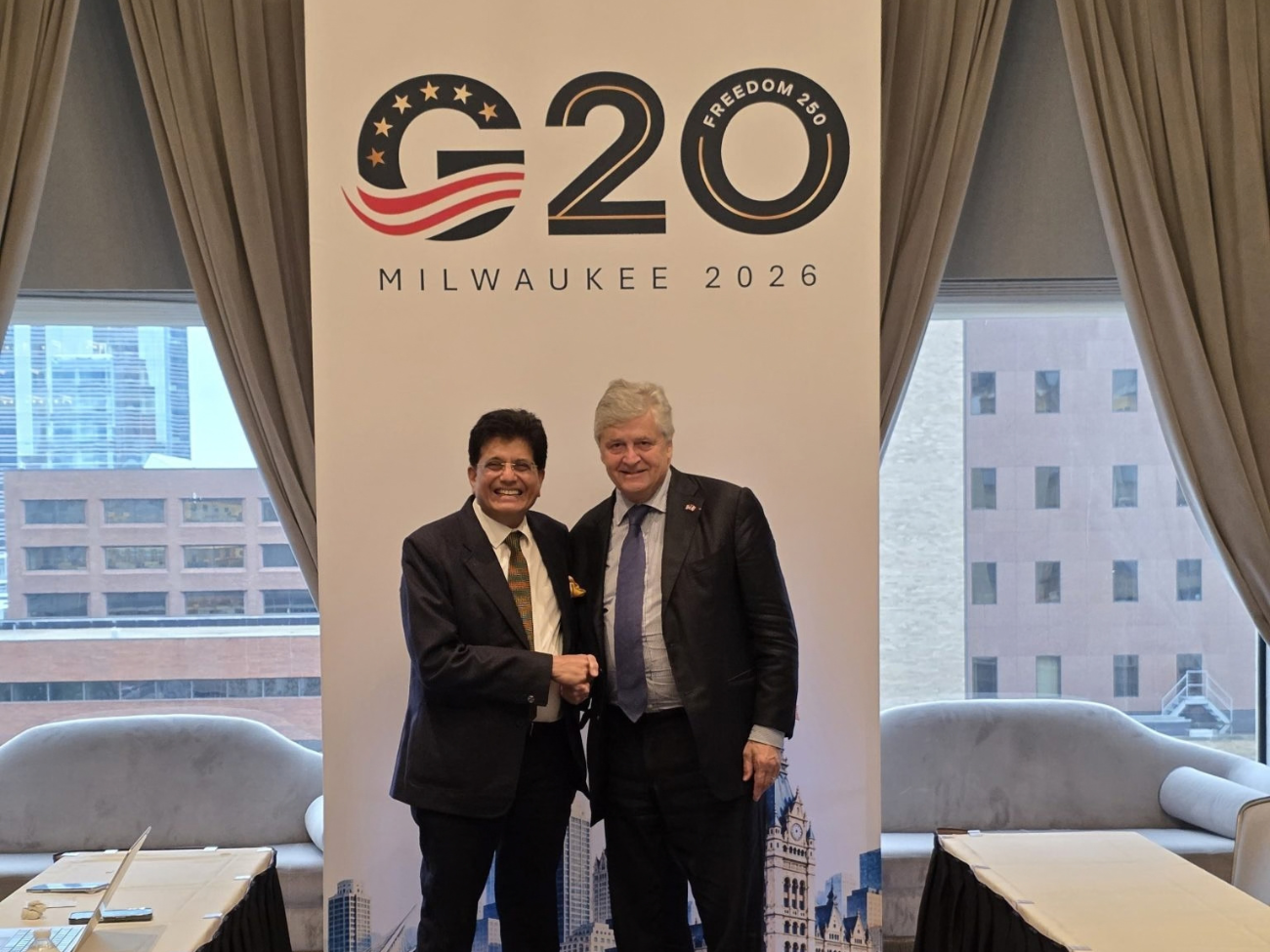
Commerce and Industry Minister Piyush Goyal has called for a WTO-compliant approach to addressing global trade distortions and structural excess capacity at the G20 Trade Ministers’ Meeting in Milwaukee, US.
Speaking on structural excess capacity and production, Goyal said India’s manufacturing capacity is geared towards meeting both domestic and global demand and that the country does not have structural excess capacity in the sectors identified by the G20 Presidency. He also highlighted India’s efforts to build manufacturing value chains from design through to finished products and strengthen its role in global supply chains.
Goyal said India shares concerns among G20 members that trade-distorting support in some economies could result in dumping and predatory pricing. He pointed to WTO-consistent measures such as anti-dumping and countervailing duties, which are based on evidence and subject to judicial review.
He said industrial capacity by itself should not be treated as the issue, while distortions could emerge when production becomes geographically concentrated because of hidden subsidies and other forms of support. According to Goyal, supply-chain diversification can be a legitimate objective but should not be used to introduce measures outside WTO rules or shift the adjustment burden onto developing countries.
On the Most-Favoured-Nation (MFN) principle, Goyal said India’s trade with G20 members depends on a transparent, non-discriminatory and rules-based trading system. He stressed the importance of maintaining policy space for developing countries and consensus-based decision-making at the WTO.
Goyal also reaffirmed India’s commitment to eliminating forced labour from global supply chains. He said trade measures related to forced labour should be based on specific and verifiable evidence rather than assumptions about entire countries, regions or sectors, while respecting due process and WTO rules.
The minister reiterated India’s support for a fair, equitable, transparent, open and inclusive multilateral trading system with the WTO at its core. He also called for policy space for developing countries to industrialise and support their populations.
On the sidelines of the G20 meeting, Goyal held bilateral discussions with trade counterparts from Australia, Saudi Arabia, France, South Korea and Canada, among others.