
Jindal Stainless capex is aimed further down the value chain.
Jindal Stainless plans to invest around ₹2,600 crore in capital expenditure during FY27, as it expands its manufacturing network and downstream processing capabilities. The company is targeting sales volumes of 3.5 million tonnes per annum by FY29, up from 2.57 MTPA in FY26, and its combined global stainless steel melting capacity has already reached 4.2 MTPA following the commissioning of a 1.2 MTPA melt shop in Indonesia, with India accounting for 3 MTPA of that total.
Read quickly, this looks like a fairly standard capacity story, a large steelmaker adding tonnage to meet growing demand. But the more revealing question isn’t how much more steel Jindal will be able to produce. It’s what kind of steel, processed to what standard, and backed by what raw-material security. That’s where the real strategy sits.
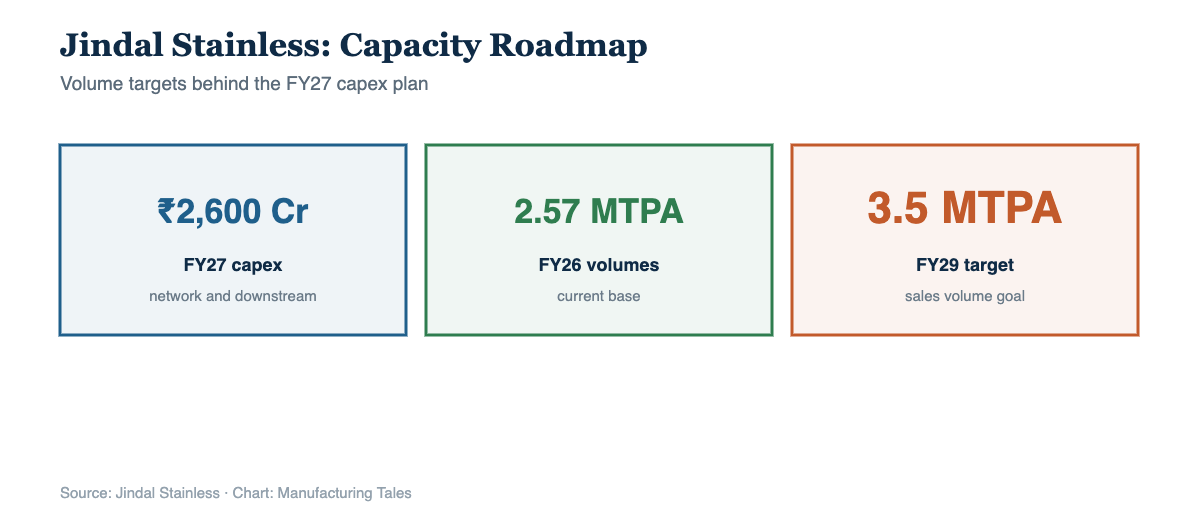 Jindal Stainless capex and volume targets from 2.57 to 3.5 million tonnes” width=”1200″ height=”520″ class=”wp-image-8710″ />
What The Jindal Stainless Capex Buys
From Producing More to Adding More Value
Steel expansion tends to get measured in tonnes, but customers don’t actually buy tonnes; they buy specifications. An automotive manufacturer needs a particular grade, thickness, surface finish and level of consistency. An appliance maker needs specific forming and corrosion-resistance characteristics. Industrial customers often need tighter tolerances and specialised grades that a standard steel mill isn’t equipped to deliver.
This is precisely why the downstream side of Jindal’s investment matters more than the topline capex figure. The company is putting ₹900 crore into expanding cold-rolling capabilities across its Hisar and Kharagpur operations, while new HRAP and CRAP facilities are being developed at Jajpur. Cold-rolling capacity is expected to rise from 2.05 MTPA to 2.67 MTPA by FY28. None of this changes how much raw steel Jindal melts, it changes how much of that steel gets converted into higher-value, more specification-ready product before it ever reaches a customer. The objective isn’t simply to sell more stainless steel. It’s to capture more of the value that currently gets created somewhere else in the chain, often by a processor sitting between Jindal and its end customer.
Why This Matters to Manufacturers Who Don’t Make an Ounce of Steel
This has a genuine ripple effect well beyond Jindal Stainless itself. When a large domestic producer expands its ability to deliver higher-value grades and processed products, downstream industries gain something that’s easy to underrate until it’s missing: a broader, more reliable local supply base.
That matters concretely for sectors like automotive, appliances, food processing, industrial equipment, infrastructure and specialised engineering — all of which depend on getting the right steel grade, on time, as part of routine production planning. When the right specification isn’t available domestically, manufacturers end up doing one of three things: importing it, at the cost of longer lead times and currency exposure; carrying extra inventory to buffer against uncertain availability; or redesigning around whatever grade happens to be locally accessible, which isn’t always the ideal engineering choice. More domestic downstream capability directly chips away at all three of those workarounds, giving manufacturers real supply-chain flexibility rather than just cheaper raw tonnage.
The Other Half of the Strategy: Owning the Raw-Material Position
It would be easy to read Jindal’s plan as purely forward-looking, with more processing and a more finished product. But the strategy extends backward into the supply chain just as deliberately. The company’s Indonesian operations give it access to nickel through a nickel pig iron facility, and the new melt shop allows that raw-material position to feed directly into stainless steel production. Jindal has also indicated a broader push toward domestic and nearby suppliers, alongside its own in-house ferro-alloy capabilities.
This backward integration matters more than it might initially seem, because raw-material volatility is one of the more disruptive forces in metals manufacturing, it ripples into production costs, pricing stability and delivery commitments almost immediately when disrupted. Owning more of the raw-material chain doesn’t just protect margins during a price spike. It buys something manufacturers value even more than cost savings: predictability. A steelmaker that can tell a customer with confidence what a grade will cost and when it will be delivered six months from now has a real competitive edge over one that’s exposed to every swing in global nickel prices.
The Digital Layer That’s Easy to Miss
There’s a part of Jindal’s plan that tends to get skipped over in coverage focused on capacity numbers: its Smart Factory 4.0 programme, which applies AI, industrial IoT, predictive analytics and real-time dashboards across manufacturing operations. At the Hisar facility specifically, an AI-driven supply-chain initiative is targeting roughly 15% lower lead times, 10% lower inventory costs and 5% higher capacity utilisation.
This isn’t a peripheral add-on to the capex story; it’s arguably what makes the rest of the investment worthwhile. Adding capacity without improving how well that capacity gets utilised tends to produce expensive, underperforming assets. Plenty of manufacturers have learned that the hard way. Adding capacity while simultaneously tightening planning, inventory and equipment utilisation creates something considerably stronger: a manufacturing system where each new investment reinforces the value of the ones already made, rather than sitting as an isolated asset waiting to be used efficiently.
Manufacturing Insight: Scale Is No Longer the Moat It Used to Be
For decades, scale was one of the most durable competitive advantages a manufacturer could build — bigger plants meant lower per-unit costs, and that was often enough to win on price. That advantage is getting harder to defend. Capacity is increasingly replicable; capital is available globally, and building a large melt shop is, relatively speaking, a solved engineering problem.
What’s much harder to replicate quickly is control over the full chain raw materials, processing depth, specialised grades, quality consistency, logistics, and the digital systems that tie all of it together. Jindal’s FY27 plan is a fairly clean example of a manufacturer recognising this shift and building toward it deliberately: more raw-material control feeds production stability, more processing capacity creates higher-value products, digitalisation improves utilisation, and a broader, more sophisticated product portfolio earns access to more demanding, higher-margin industrial customers. Each piece reinforces the others. That’s the real distinction between a company that’s simply gotten bigger and one that’s built a genuinely more integrated manufacturing platform, and it’s this second kind of growth that tends to be far harder for competitors to copy.
The Ripple Effect
If this kind of investment scales across India’s steel sector and Jindal is unlikely to be the only large producer moving this direction the impact is likely to extend well beyond stainless steel itself.
Automotive and appliance manufacturers stand to gain the most direct benefit, as broader domestic availability of specification-grade stainless steel reduces their dependence on imports and shortens lead times for components that require tight tolerances and specific finishes.
Precision fabrication and tooling companies are likely to see growing opportunity, since higher-value steel grades open the door to more sophisticated downstream fabrication work, the kind that commands better margins than processing basic commodity-grade material.
Quality inspection and testing service providers become more central to this ecosystem as steel producers and their customers both push toward tighter specifications and greater consistency, particularly for industries like automotive and infrastructure where failure tolerances are minimal.
Industrial engineering and design firms gain more flexibility when a wider range of domestic steel grades becomes reliably available, since materials availability directly shapes what a design team can specify without defaulting to imported alternatives.
Nickel and ferro-alloy suppliers, both domestic and regional, may see steadier long-term demand as large producers like Jindal formalise backward-integrated supply relationships rather than relying purely on spot markets.
Digital manufacturing and industrial automation vendors benefit as more large manufacturers follow Jindal’s lead in pairing capacity expansion with AI-driven planning and predictive maintenance systems, a trend that tends to spread quickly once a major player demonstrates measurable results.
Logistics and supply-chain service providers serving the metals sector are likely to see rising demand as producers and downstream customers alike prioritise delivery reliability and lead-time reduction as competitive differentiators, not just cost line items.
Manufacturing Takeaway
The next phase of Indian manufacturing may not be defined primarily by who can produce the most. It’s increasingly likely to be defined by who controls the most valuable parts of the production chain raw materials, processing depth, specialised products, digital intelligence, and the supply-chain relationships built around all of it.
Jindal Stainless’ FY27 capex plan is a useful, concrete example of that shift already underway. The company isn’t simply adding tonnes to a production number. It’s building control over materials, over processing, over product sophistication, and over the data that tells it how efficiently all of it is running. That combination, more than the ₹2,600 crore figure itself, is what actually makes the investment competitive.