

Although production numbers for vehicles with combustion engines are declining, they remain substantial—approximately 75 million cars are manufactured annually. This provides the industry with plenty of incentive to keep refining series production processes. MAPAL is supporting these efforts by offering new tooling solutions tailored for modern combustion and hybrid engines.
The automotive industry continues to focus on cutting cycle times and lowering the cost per part. Through two examples—crankshaft manufacturing and valve seat machining—MAPAL demonstrates how combining processing steps with innovative tooling technologies can effectively achieve these goals.
Drilling and Deburring in a Single Step
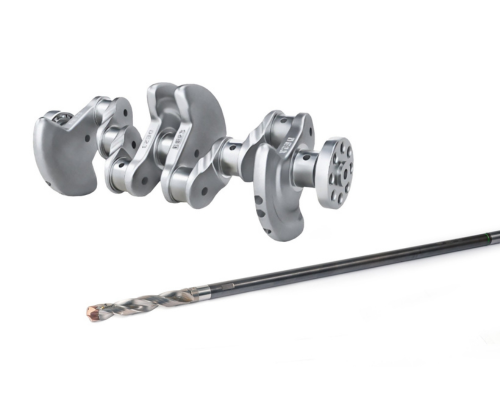
The push to reduce weight—and therefore fuel consumption—by minimizing moving mass extends even to traditional components like the crankshaft. A central relief bore runs through the entire crankshaft to remove material. Given the crankshaft’s shape, the tool repeatedly enters and exits the material during machining, with the number of passes depending on the engine’s cylinder count.
This also dictates the required drill length. To machine the entire crankshaft in a single operation, tools ranging from 600 to 800 mm in length are necessary. MAPAL addresses this with a modular system. The drill body uses a special replaceable head holder featuring the TTS (Torque Transfer System) connection, which ensures an exceptionally stable joint. This MAPAL connection provides optimal torque transmission along with high repeatability and radial run-out accuracy. To achieve the necessary tool length, the holder is attached to an extension. At the tip, a TTD replaceable drill head is used, available in various geometries depending on the machine’s performance.
One of the key challenges in machining is the formation of burrs as the drill enters and exits the metal. Previously, these burrs were removed in a separate operation. MAPAL now offers a one-shot solution that enables simultaneous drilling and deburring. This is achieved through a modular combination tool featuring an additional chamfer insert positioned just behind the drill head. The SNAP18 module, a miniaturized deburring system developed specifically for this application by HEULE Precision Tools, is integrated into the setup. For dependable forward and reverse deburring, a small spring controls the insert, ensuring that the pre-drilled diameter is chamfered with precision—down to the nearest tenth—without causing any damage during the process.
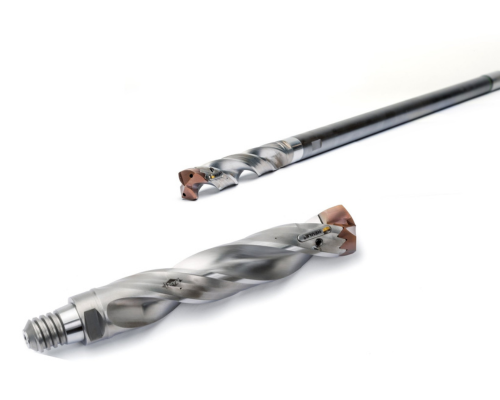
This tool solution saves the user a step and a space for a tool in the magazine. The cycle time is reduced.
Twelve-Edge Insert for Valve Seat Machining
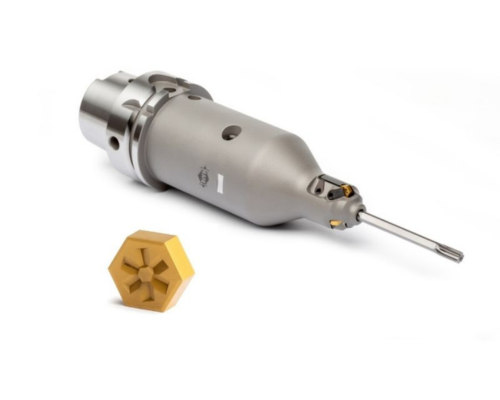
To cut costs in the fine machining of valve seats, MAPAL has introduced the innovative HNHX indexable insert. Like its predecessor, the HNHX is hexagonal—but now allows for twelve cutting edges instead of six. This is made possible by a negative installation position that enables the insert to be rotated. A redesigned clamping star ensures maximum force closure and precise positioning within the insert seat. Achieving ultra-precise machining of the valve seat ring is crucial to meet stringent tolerances and surface quality requirements. With the HNHX insert, surface roughness values of less than Ra 2.0 are consistently achieved.
MAPAL recommends a combination tool for machining the valve seat and valve guide. In one machining step, the tool first machines the valve guide and then the valve seat with the HNHX indexable insert.
Enhanced Efficiency for Larger Valve Seat Rings
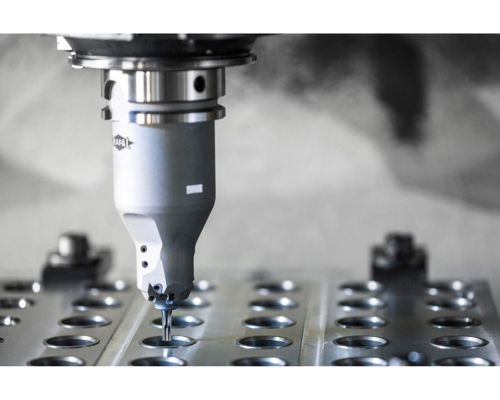
Depending on the valve seat design, the HNHX indexable inserts can be used significantly more than 12 times. When construction allows—such as in larger valve seat rings for lorries—these inserts can be utilized twice, providing up to 24 cutting edges. This is achieved by removing the worn cutting edge after its tool life ends and repositioning the insert at a different angle. A special coating helps users easily identify which cutting edges have been used, enabling straightforward repositioning in a new insert seat to continue machining with a fresh, unused portion of the edge.
Doubling the number of cutting edges has a direct effect on production costs: it cuts the cost per part in half. Tool life is also extended through the use of PcBN high-performance cutting materials developed by the MAPAL Group. These cutting materials are tailored to keep pace with industry advancements, improving the wear resistance of valve seat rings by incorporating innovative materials. The sturdy clamping system ensures maximum force closure, resulting in an even force distribution within the insert seat.
Despite the growing shift toward e-mobility, development in combustion engines continues—particularly for modern hybrid vehicles. MAPAL stands by its customers as a trusted technology partner and will continue supporting the optimisation of their production processes in the years ahead.