

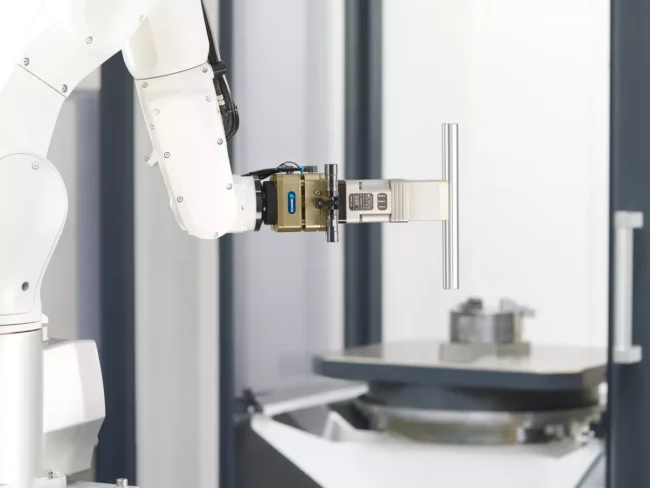
SCHUNK’s modular AGM compensation unit sets a new standard in automation by ensuring precise correction of tolerances in robot-assisted processes. Designed for flexibility and reliability, the product family is part of the advanced Robot PLUS portfolio and supports a broad range of applications.
In manufacturing environments where inaccuracies or process tolerances can arise, the AGM delivers exceptional performance. Its modular design, combined with patented technologies, allows it to handle payloads ranging from just a few grams up to 400 kilograms.
The portfolio offers more than 50 variants, enabling compensation across all directions (XY, Z, W, XYZ, and WZ). This extensive range ensures that manufacturers can select the ideal solution for virtually any robotic application, making the AGM a key enabler for modern, high-precision production.
AGM-XYZ: Reliable Precision in Machine Loading
In machine tool loading and unloading, even small tolerances can cause collisions between the gripper and workpiece—disrupting processes and leading to costly errors. The AGM-XYZ variant addresses this challenge by compensating for such inaccuracies, ensuring higher process stability.
With compensation capability across the X, Y, and Z axes, the unit enables precise positioning of components, minimizing interruptions and supporting seamless operation. For added flexibility, patented manually adjustable spring cartridges are available to keep the unit centered. Depending on the size, different force ranges can be set, making weight compensation highly adaptable.
Optional integrated sensors provide reliable feedback on the locking and unlocking of the AGM, without creating additional interfering contours. This makes process monitoring easier while maintaining maximum reliability.
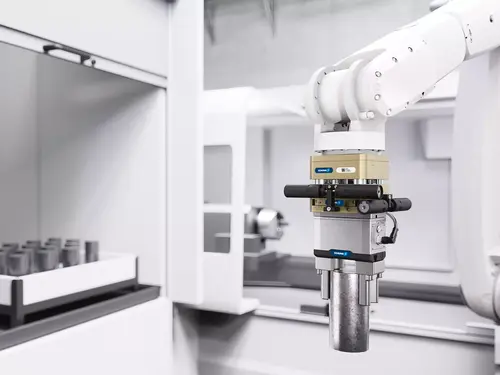
AGM-XY: Optimized Joining Processes for Reliable Quality
Automated joining processes often face challenges from positioning errors or component tolerances, which can result in scrap, rework, or production downtime. Given the variety of parts involved—from delicate electronic boards to heavy engine blocks—a precise and flexible compensation solution is essential.
The AGM-XY variant provides this reliability by compensating for inaccuracies along the X and Y axes, making joining processes more stable and efficient. Its manually adjustable stroke allows for flexible adaptation of the compensation path, while the smooth guidance system is especially well-suited for handling fragile or sensitive components.
For more demanding applications, the stroke limitation feature enables precise adjustment of shorter strokes, ensuring accuracy even in challenging joining tasks. Compact in design, the AGM-XY is also ideal for use in space-restricted environments.
AGM-W: Boosting Efficiency in Bin Picking
One of the greatest challenges in bin picking is the undefined position of components. Parts must be detected, securely gripped, and removed without collisions—yet their orientation often shifts during handling, leading to misgrips, delays, or even damage.
The AGM-W addresses this with angular compensation, enabling the gripper to pick components in varying positions without the risk of jamming. Its compensation force can be finely adjusted using compressed air, ensuring precise alignment—even when parts are tilted. Optional sensors further support process monitoring for reliable operation.
Equipped with pneumatic locking and unlocking, the AGM-W supports highly dynamic movements with fast travel paths. This capability ensures efficient, damage-free separation and complete emptying of bins, even when handling fragile parts. The result: higher productivity, reduced downtime, and greater reliability in automated storage and logistics processes.