
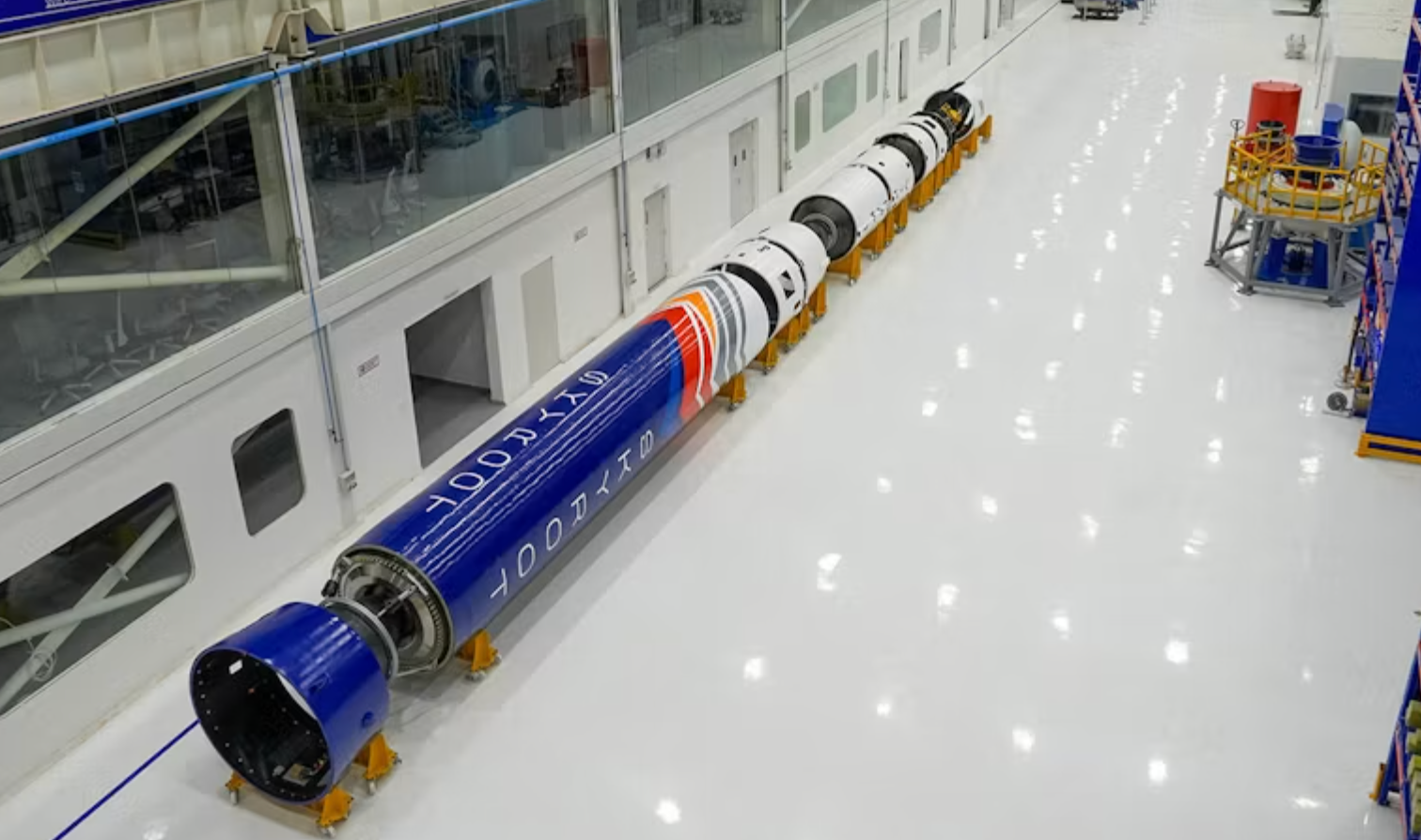
Skyroot Aerospace’s Vikram-1 lifted off from Sriharikota on 18 July 2026 and reached a 450-kilometre low Earth orbit, the first privately developed Indian rocket to get there. The flight places India third, after the United States and China, among countries with private orbital launch capability. The vehicle, flown as Mission Aagaman, is a four-stage small-satellite launcher rated for 350 kg to LEO, built around an all-carbon-composite structure and a 3D-printed liquid engine.
Behind Skyroot Vikram-1, by co-founder Naga Bharath Daka’s own account: roughly 1,000 people, more than 400 suppliers, close to 3,000 days of work.
That last set of numbers is the real story.
ManufacturingTales Take
Skyroot Vikram-1 is a manufacturing achievement that happens to have flown.
For years, Indian private firms in space built parts and subsystems for ISRO-led missions. Vikram-1 is the first time an Indian startup has designed, built and flown a complete orbital vehicle on its own: propulsion, avionics, payload integration, launch operations. That is precisely the transition Indian manufacturers have been attempting for two decades across automotive, aerospace and machine tools, moving from Tier-2 component supply to owning the full system, the specification and the customer. Space is simply where it became impossible to ignore.
Which brings us to those 400 suppliers.
Behind one rocket sits a distributed base of Indian firms machining, winding, casting and certifying hardware to aerospace tolerances: composites, precision machining, propellant casting, fasteners, avionics, ground support equipment. Most are small and mid-sized engineering companies. Qualifying for launch-vehicle work forces a step change in metrology, process documentation, traceability and non-conformance handling, and none of that discipline stays confined to space work. It carries straight into defence, medical devices and high-end automotive. The certification is portable. The rocket was only the occasion for earning it.
But qualifying a supplier and running one at a rate are different problems.
Skyroot has stated an objective of scaling to a facility capable of building one rocket a month. That is not a rocketry challenge; it is a production engineering one, and historically it is where Indian manufacturing has struggled most. Building one of anything to specification is achievable with good people and enough time. Building twelve a year demands stable supplier lead times, processes designed for repeatability rather than heroics, fixtures built for rate, inspection that does not become the bottleneck, and vendors willing to hold inventory against a schedule. Every one of those 400 firms now has to convert a project mindset into a rate mindset. Capital buys tooling, test hardware and floor space. It cannot buy process maturity.
One structural detail is worth carrying away. The private vehicle flew on public infrastructure. ISRO supplied motor casting and test facilities, liquid-engine testing, trajectory analysis, safety support, vehicle integration and the launchpad itself, while IN-SPACe’s Technology Adoption Fund covers up to 60% of project cost for startups and MSMEs, capped at ₹25 crore. Shared access to capital equipment is what let a firm of Skyroot’s size attempt this at all, and the binding constraint on Indian MSMEs in tooling, testing and metrology is rarely skill. It is almost always access to equipment they cannot justify buying alone.
Why this matters
Skyroot is not an outlier, and the capital behind this sector has stopped being speculative.
Skyroot itself raised about $60 million in May 2026 at a valuation above $1.1 billion, becoming India’s first space-tech unicorn. Chennai’s Agnikul Cosmos has raised roughly $75 million across eleven rounds, and is building an integrated manufacturing and testing campus on 350 acres allotted by the Tamil Nadu government. Pixxel has raised about $96 million building hyperspectral imaging satellites. Digantara closed a $49.1 million round led by Reliance Industries with Peak XV, the largest in Indian spacetech in 2025. Dhruva Space took the maiden ₹60 crore deployment from the ₹1,600 crore Antariksh Venture Capital Fund, anchored by a ₹1,000 crore IN-SPACe commitment.
Read that list again and notice what the money is buying: campuses, test beds, engine cells, clean rooms, supplier qualification. This is a factory build-out wearing a technology label.
Now the scale check. Ninety funded Indian spacetech firms have collectively raised around $869 million. The sector draws roughly 1.3% of global spacetech capital and has produced no major exits yet. One Chinese rocket developer, Space Pioneer, raised $351 million in a single round in October 2025, more than India’s entire private spacetech sector attracted between 2022 and late 2025.
Which settles what the differentiator cannot be. India will not win this on capital deployed; that contest is already lost by an order of magnitude. It can only win on cost per unit and cadence, which is to say, on manufacturing.
India has repeatedly shown it can build a first article to world standards: a prototype, a demonstrator, a maiden flight. What it converts into industrial advantage far less often is the twentieth unit, delivered on time, at cost, identical to the first. Vikram-1 proved the capability. The build rate will decide whether this becomes an industry or stays an achievement.