
The Sigma Advanced Systems raise is a defence manufacturing signal.
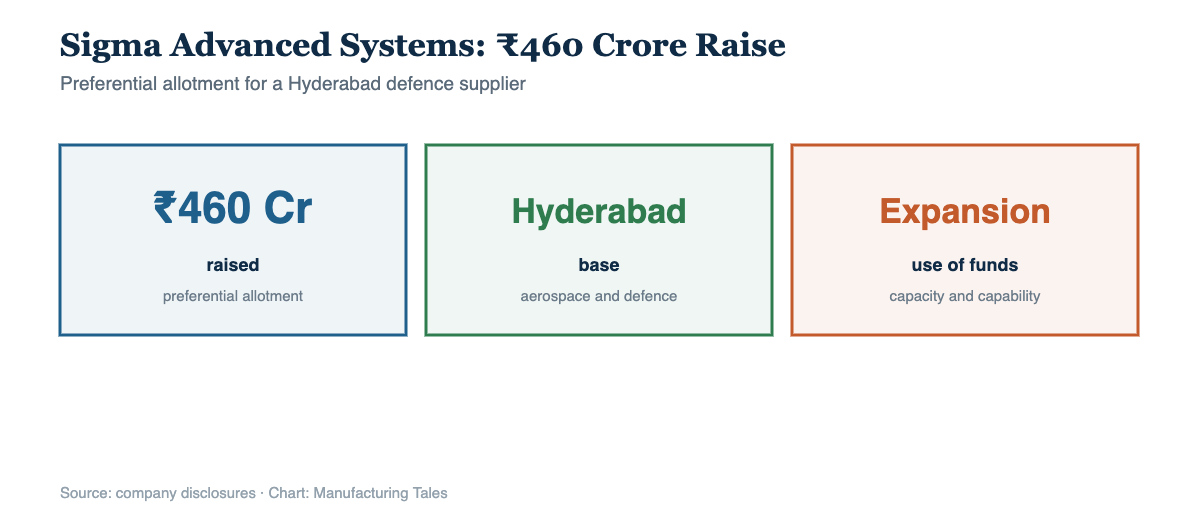
A ₹460 crore capital raise can look like a straightforward corporate funding story. For Sigma Advanced Systems, the timing and purpose make it considerably more interesting. The Hyderabad-based aerospace and defence manufacturer has raised approximately ₹460 crore through a preferential allotment, intended to support expansion and the company’s growing international ambitions, ambitions it’s already pursuing through overseas acquisitions and large global customer programmes.
The company recently acquired UK-based Bromford Precision Solutions, while reports also point to a ₹3,800 crore contract from Rolls-Royce. So the more interesting question isn’t simply what Sigma will do with ₹460 crore. It’s what kind of manufacturing company Sigma is actually trying to become.
What The Sigma Advanced Systems Raise Funds
From Indian Supplier to Global Manufacturing Platform
For years, one of India’s biggest manufacturing advantages has been its ability to supply global companies at competitive cost, a model that drove real growth in automotive components, engineering, pharmaceuticals and industrial products. Aerospace and defence demand something considerably harder. A supplier here must demonstrate consistent quality, advanced manufacturing capability, full traceability, certifications, and the ability to support programmes reliably over years, not quarters.
That raises the bar for the next stage of India’s manufacturing journey. Manufacturing competitively in India is no longer enough on its own companies increasingly need to become globally embedded suppliers, and Sigma’s recent moves suggest that’s precisely the direction it’s pursuing.
Why the UK Acquisition Matters
An overseas acquisition can look like simple geographic expansion. In manufacturing, it’s often far more strategic. A company like Bromford Precision Solutions brings access to an established customer base, existing manufacturing capabilities, certifications and relationships already embedded within an international aerospace ecosystem, credibility that’s genuinely difficult to build organically. Rather than spending years earning trust in a new market, an acquisition provides an existing platform to expand from immediately.
That creates a compelling model: Indian manufacturing scale combined with international capability and global customer access, increasingly important as more Indian companies attempt to move up aerospace and defence supply chains.
Why The Timing Matters
The Rolls-Royce Connection Raises the Stakes
Sigma’s reported ₹3,800 crore Rolls-Royce contract adds another dimension. Long-term programmes with global aerospace companies demand far more than production capacity, they require suppliers to maintain consistent processes, quality and delivery over years. Machinery investment is only one part of the equation. The manufacturer also needs strong process control, advanced inspection, full traceability, skilled engineering talent, supplier qualification systems and genuine programme management capability.
This is where capital becomes useful. The objective isn’t simply to buy more machines, it’s to build the manufacturing system around those machines.
The Bigger Opportunity for Indian Manufacturing
Sigma’s story matters well beyond one company. India already has thousands of engineering and manufacturing firms with strong capabilities in precision machining, fabrication, electronics and specialised components. The persistent challenge has been moving from being a capable supplier to becoming one that global OEMs can depend on for critical, failure-intolerant programmes.
Aerospace and defence work can accelerate that transition. Once a company builds the quality systems and manufacturing discipline demanding aerospace customers require, those capabilities tend to translate into other high-value sectors too, creating a wider industrial multiplier that extends beyond the original contract that forced the discipline.
Why Global Expansion Differs From Exporting
Exporting means producing in India and selling abroad. A global manufacturing platform means having capabilities, people, customers and operations across multiple markets simultaneously offering closer proximity to customers and deeper integration into international supply chains, while still combining India’s cost and engineering advantages with the specialised capabilities overseas operations provide. That hybrid model could become an increasingly important template for India’s next generation of industrial companies.
Capital as a Manufacturing Enabler
Seen this way, the ₹460 crore raise is interesting from another angle. Manufacturing expansion requires patient capital new aerospace programmes often demand investment in machinery, tooling, testing, certification and engineering well before commercial returns materialise. Organic cash generation frequently can’t fund that expansion fast enough on its own, which is where strategic capital accelerates the transition. The real question is what happens after the capital is raised: does it create additional production capability, bring new customers, improve technology, and deepen integration into global supply chains? Those outcomes matter more than the fundraising headline itself.
The Ripple Effect
If Sigma successfully scales its global platform, the impact is unlikely to stay contained within the company. Larger aerospace and defence programmes tend to create opportunities across Indian Tier-2 and Tier-3 suppliers, precision machining, castings and forgings, tooling, electronics, surface treatment, inspection, testing and specialised engineering firms all stand to benefit. A ₹3,800 crore customer programme doesn’t stay with one manufacturer; it eventually creates demand across an entire supplier network, turning a single contract into a genuine ecosystem opportunity.
The More Important Shift
There’s a larger transition underway in Indian manufacturing, moving from “make it in India” toward “build the capability in India and participate globally.” That’s a considerably harder proposition, requiring companies to compete not just on cost but on technology, quality, delivery, engineering and reliability. In aerospace and defence, where failure simply isn’t an acceptable outcome, that bar sits particularly high.
Sigma raising ₹460 crore, then, isn’t just a funding event. It’s a signal of how ambitious Indian aerospace and defence companies are trying to scale, acquiring capabilities, building international presence, securing global programmes, and carving out a deeper position within international supply chains. The real measure of success won’t be the capital raised. It will be whether that capital helps build genuinely globally competitive manufacturing capability from India, and that’s the story that matters more.