
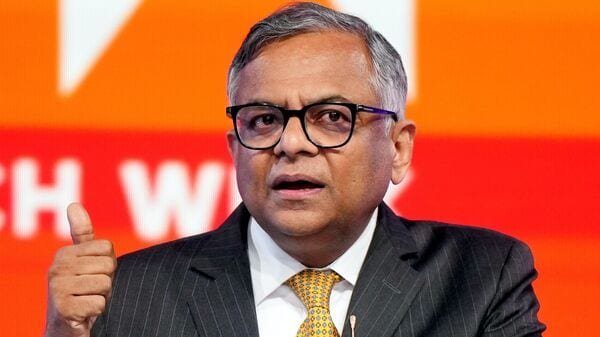
N Chandrasekaran told the Tata Sons board today, that he will not seek reappointment when his term ends on February 20, 2027. Markets read it as a shock even though it is not a walkout. TCS, the group’s most valuable listed company, fell nearly 5% to a low of ₹2,322 on the BSE, the steepest drop in the group. The Sensex ended 544 points lower. A single line in a letter to the board moved the country’s largest IT stock more than most earnings prints do.
Start with what actually happened, because the word resignation is doing too much work in the headlines. Chandra is not leaving now. He will serve out the remainder of his term to February 20, 2027, and has asked the board to decide on succession soon to ensure a proper transition. What he has withdrawn is his candidacy for another five years. His reappointment was recommended unanimously by the two main Tata Trusts and by Tata Sons’ own nomination committee, then tabled at the board on February 24, 2026, where it did not pass because one director withheld support, understood to be Noel Tata. Six months on, with no resolution, Chandra chose to remove himself rather than let the deadlock hang over a group mid-execution on several large projects. He has spent 40 years at the group: joined in 1987, ran TCS as CEO from 2009, and took over Tata Sons in February 2017.
The market reaction was concentrated where the ownership is tightest. Beyond TCS, Tata Motors’ passenger vehicle arm fell 2.01%, Tata Consumer 1.6%, Titan 1.22%, Tata Power 1.09%, Tata Steel 1.03% and Indian Hotels 0.84%, with Tejas Networks down 2.08%. TCS is now down more than 27% for the year. Tata Chemicals was the one gainer, up around 2%. The pattern tells you this is a governance and continuity repricing rather than a business shock. Nothing changed in any operating company today. What changed is the certainty around who steers the holding company that controls all of them, and the market took its discount out of the names where Tata Sons owns the most.
That uncertainty lands hardest on the programmes that need a steady sponsor the most. Under Chandra, Tata pushed into the most capital-heavy manufacturing it has ever attempted. The ₹91,000 crore chip fab at Dholera, built with Taiwan’s PSMC, is targeting its first output by December 2026, just two months before his term ends. There is a ₹27,000 crore assembly and test plant in Assam, battery capacity under Agratas including a 40 GWh gigafactory in the UK, and the ongoing cash burn of rebuilding Air India. As one brokerage put it, a change at the top could slow the big bets on semiconductors, EV batteries and Air India, or it could reset expectations on cash burn. A fab is a decade-long commitment where yield ramps and follow-on capital depend on a sponsor who stays the course. Handing that over mid-build, at the exact point of first production, is the part investors are pricing.
Sitting underneath all of it is the question Tata has spent years trying to avoid: whether Tata Sons itself must go public. The RBI classified Tata Sons as an Upper Layer NBFC in September 2022, which carries a three-year listing requirement. Tata Sons has asked to be deregistered as a Core Investment Company so it can skip the IPO. On August 6 the RBI kept it on the Upper Layer list for 2026-27, without prejudice to that pending application, leaving the listing mandate alive. The shareholders want opposite outcomes. Tata Trusts, with 66%, opposes a listing because it would dilute its control, while Shapoorji Pallonji, with over 18% and under financial stress, wants one to monetise its stake. The reappointment fight was tangled in exactly this: Noel Tata’s objection reportedly came with a demand for a written commitment against a future listing. The chairman question and the listing question are the same fight wearing two faces.
So the group now runs two clocks at once. One is the succession the board has been asked to start, with a contentious AGM already set for August 18. The other is the RBI’s open-ended review of the listing exemption. Whoever takes the chair inherits both: a semiconductor-and-batteries capex programme that will consume cash for years, and a decision about whether that spending happens on a private balance sheet or a public one. For anyone holding the listed Tata names, today’s fall is the market pricing that double uncertainty. The businesses did not change. The question of who decides their future, and how openly, just did.