
For two decades, India’s manufacturing sector has been telling the same story about itself: full of potential, short on delivery. It has hovered at roughly 17% of the country’s gross value added since the mid-2000s, refusing to budge much in either direction, while the government’s own ambitions, a $30 trillion economy by 2047, quietly assume that this number has to move.
This week, NITI Aayog and Crisil Intelligence put a number on the plan to move it. Vice Chairperson Ashok Kumar Lahiri released Key Sectors to Position India as a Global Manufacturing Hub, a report that does something Indian industrial policy has rarely done cleanly before: it picks favourites, on purpose, with the analysis to justify it.
From 62 Contenders to 12 Bets
The headline number is the filtering itself. Crisil’s team screened 62 manufacturing sectors and narrowed them to 12 where India can realistically aim for global leadership: electronics, telecom equipment, solar PV, pharmaceuticals, chemicals, automobiles, defence and drones, steel, capital goods, textiles, food processing, and leather and footwear.
The filter wasn’t a gut call. It ran through four phases: a market-size-and-growth screen to get from 62 down to 12, a deeper stress test of each shortlisted sector on strategic fit, financial viability and value-chain positioning, a benchmarking exercise against two global leader nations per sector, and a round of industry consultation to ground the recommendations in what manufacturers actually face on the ground.
This first volume digs into four of the twelve chemicals, textiles, telecom and network equipment, and solar photovoltaic manufacturing, with two more volumes covering the remaining eight sectors still to come.
Why the Old Number Won’t Cut It
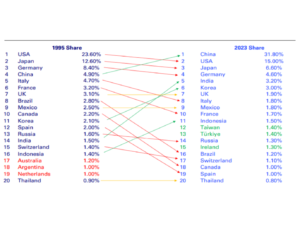
The report doesn’t dance around the comparison that makes the case for urgency. Between 1995 and 2023, China’s share of global manufacturing value-added rose from roughly 5% to nearly 32%. Over the same period, India’s share moved from about 1.5% to 3.2%, real progress, but nowhere near enough to shift India’s position in the global pecking order. India is currently the world’s fifth-largest manufacturer by some measures, yet accounts for only about 3% of global manufacturing output.
What’s notable is that the report doesn’t treat this gap as a failure of effort. Initiatives like GST, Make in India, the Production Linked Incentive schemes, PM Gati Shakti and the India Semiconductor Mission have all been in motion. The diagnosis instead is that broad-based, generic support has run its course, the next phase needs to be sector-specific, and it needs to know exactly where to point.
The Ripple Effect
The reason this filtering exercise matters beyond policy circles is demographic, not just economic. India’s median age is around 28. NITI Aayog’s own framing is blunt about what that means: manufacturing is the most effective pathway to convert that demographic dividend into broad-based prosperity, because it’s one of the few sectors that can absorb labour at scale across every skill level, not just the top end.
That’s also why the report leans hard on cluster-based manufacturing as a recurring recommendation across all four sectors it examines. Shared infrastructure, integrated industrial parks, and faster approvals show up repeatedly in the report’s global benchmarking because scattered, individually permitted factories don’t compete well against countries that built entire ecosystems around a handful of chosen industries.
Manufacturing Insight
If you’re in manufacturing or advising, financing, or supplying into it, this report is worth reading less as a government document and more as a forward signal. Sectors that make this list of 12 are the ones most likely to see the next wave of PLI-style incentives, infrastructure investment, and regulatory attention concentrated toward them over the coming years. The four sectors detailed in this first volume chemicals, textiles, telecom equipment and solar PV are as good a place as any to start paying closer attention, because policy tends to follow analysis like this a lot faster than it follows hope.
Over the next three issues, we go deep on each of these four sectors individually, what’s actually working, what’s structurally broken, and where the real opportunity sits for manufacturers willing to move early.