
As India looks to position itself as a global manufacturing hub, the conversation is increasingly moving beyond individual products and factories. The bigger question is whether India can build the industrial ecosystems needed to support them at scale — from raw materials and components to technology, infrastructure and specialised inputs.
The latest NITI Aayog–Crisil Report on Key Sectors to Position India as a Global Manufacturing Hub puts that question into perspective by identifying sectors where India has both a strong existing base and significant room to expand. Chemicals stand out in that conversation not simply because of the size of the industry, but because of what sits downstream of it.
Big Market, Bigger Headroom
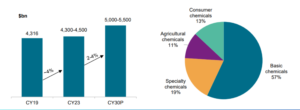
The global chemicals market is projected to grow from roughly $4,300–4,500 billion in 2025 to $5,000–5,500 billion by 2030, a modest 2–4% CAGR globally. India’s own domestic chemicals market, by contrast, is expected to grow far faster, reaching $290–310 billion by FY30, with an explicit ambition to lift India’s share of global chemical consumption to 5–6%.
Independent trade estimates broadly back this growth trajectory: IBEF projects India’s chemicals sector attracting sustained investment on the back of liberalised FDI norms, the sector has already pulled in roughly $23.9 billion in FDI between April 2000 and December 2025, alongside a speciality chemicals segment growing fast enough to be labelled one of India’s most promising sub-sectors for exports (IBEF). Separately, India Briefing has tracked India’s broader chemical industry ambitions toward the trillion-dollar mark by 2040, driven largely by rising speciality and petrochemical demand (India Briefing).
The Catch: India Makes the Dough, Not the Bread
Here’s where the report gets genuinely interesting instead of just optimistic. India’s chemical feedstock allocation is skewed heavily toward bulk commodities rather than complex, higher-value downstream derivatives. Most of India’s propylene goes into polypropylene; most of its ethylene goes into polyethylene. That’s the industrial equivalent of growing wheat and stopping there; you’re not capturing the margin that comes from turning it into bread, pastries, or anything more specialised.
Speciality chemicals — dyes, agrochemicals, surfactants, construction chemicals, flavours and fragrances — are where the real margin sits, and India is already a net exporter in agrochemicals and colourants. But it remains import-dependent in polymer additives and surfactants, precisely the kind of specialised, high-value segments the report argues India needs to build out.
The infrastructure gap compounds this. The report points to global models like Jurong Island in Singapore and the Rotterdam chemical hub, where anchor investments, shared utilities, integrated pipelines and fast, coordinated approvals let chemical clusters scale far faster than India’s currently fragmented approach allows.
Global chemicals industry and segment-wise share of the chemicals industry
The Ripple Effect
Because chemicals sit invisibly inside a dozen other “hero” industries, weaknesses here don’t announce themselves loudly; they show up as quietly elevated costs elsewhere. A pharma company paying more for an imported intermediate, a textile mill paying more for dyes, and an auto components maker paying more for polymer additives – none of these show up as a “chemicals problem” in the headlines, but they all trace back to the same upstream gap the report is flagging.
Manufacturing Insight
The practical signal for manufacturers and investors: the opportunity isn’t in adding more basic chemical capacity, India already has plenty of that story to tell. It’s in the derivatives layer and in speciality chemicals and in positioning early around shared-infrastructure chemical parks (PCPIRs) that the report explicitly calls out as underdeveloped relative to global peers like Jurong Island. Expect policy incentives, viability-gap funding, and infrastructure spend to increasingly concentrate on import substitution for critical chemicals and downstream integration, not on expanding what India already produces in bulk.