

Of the four sectors highlighted in NITI Aayog and Crisil’s new roadmap for positioning India as a global manufacturing hub, textiles may have the deepest connection to India’s economic and social fabric.
It is not just a large export industry. It is one of India’s biggest sources of employment, the country’s second-largest employer after agriculture, providing livelihoods to more than 45 million people. And unlike manufacturing sectors dominated by a handful of large plants, textiles have a remarkably distributed industrial base: nearly 80% of industry capacity is concentrated in MSME clusters.
That makes textiles particularly important to the manufacturing story NITI Aayog is trying to build. The opportunity is not simply about adding more factories or increasing production. It is about connecting India’s enormous network of fibre producers, spinning mills, processors, garment manufacturers, MSMEs and exporters more effectively to global value chains.
India already has scale. In FY2025, the country exported $37.7 billion worth of textile products, accounting for 4.1% of global textile and apparel exports and making India the world’s sixth-largest textile exporter. But the government’s ambition is considerably larger: $100 billion in textile exports by 2030. That would mean taking the sector from an established global position to a substantially larger share of international trade. The target has also been accompanied by a broader push to strengthen India’s textile value chain, from fibre and manufacturing to fashion and global markets.
And that is what makes textiles interesting in the context of India’s manufacturing ambitions. The question is no longer whether India can make textiles at scale. It is whether India can capture much more of the value created along the way.
A Target Built on a Shifting Foundation
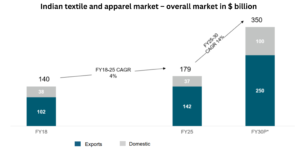
That target isn’t just NITI Aayog’s framing; it’s been consistent government messaging for a while now. Commerce Minister Piyush Goyal has repeatedly reaffirmed the $100 billion export goal, alongside a broader ambition to roughly double the size of the overall textile industry itself, from around $140 billion currently toward $250–300 billion by 2030 (TEXtalks). IBEF’s own industry tracking shows textile and apparel exports at $35.52 billion in FY26, inching toward that number but with a long way still to go (IBEF).
Here’s the tension the GMH report puts its finger on directly: India’s traditional strength is cotton. It’s among the world’s largest cotton producers, accounting for roughly 22% of global output, and remains the largest exporter of cotton yarn. But the global textile market has been steadily shifting toward man-made fibres (MMF), particularly polyester, because of durability, wrinkle resistance and suitability for technical and performance applications. Over the past several years, India’s cotton yarn production has actually declined while MMF production has climbed. The country that built its textile identity on cotton now needs to become genuinely competitive in a fibre category it didn’t specialise in.
Where the Competition Is Already Ahead
The report doesn’t shy away from an uncomfortable comparison. Bangladesh built its garment export dominance through competitive labour costs, dedicated export zones, and preferential trade access. Vietnam did it through deep trade integration, strong FDI inflows, and specialised industrial parks tightly linked to global supply chains. Both countries, despite lacking India’s raw material base, have outcompeted it on market access and manufacturing scale in exactly the segments of MMF-based garments where global demand is growing fastest.
On the ground, India’s policy response is already visible. The PM MITRA Parks initiative plug-and-play textile infrastructure, has approved seven parks across states, including Tamil Nadu, Telangana, Gujarat, Karnataka, Madhya Pradesh, Uttar Pradesh and Maharashtra, backed by an outlay of roughly Rs 4,445 crore (The Hans India). Investindia’s own sector tracking places MMF and technical textiles at the centre of India’s push toward the 2030 target, precisely because they’re less exposed to fashion-cycle volatility than traditional garment exports (Investindia).
Indian textile and apparel market – overall market in $ billion.
The Ripple Effect
This is the sector where manufacturing growth and inclusive growth are most directly the same conversation. Rural employment, women’s workforce participation, and the survival of MSME clusters that make up 80% of the industry’s capacity all ride on how successfully and how fast India makes this MMF pivot. A failure here doesn’t just miss an export target; it stalls the livelihoods of tens of millions of people who depend on an industry still organised around yesterday’s fibre mix.
Manufacturing Insight
For manufacturers and investors watching this space, the signal is fairly clear: expect continued and probably accelerating policy support toward MMF capacity, technical textiles, and weaving-and-processing modernisation through the PLI Scheme for Textiles, PM MITRA Parks, the Samarth skilling programme, and the newly announced Mission for Cotton Productivity. Businesses still organised purely around cotton risk being structurally left behind as both domestic policy and global demand keep tilting toward MMF and technical applications. The MSMEs and mills that diversify their fibre base early are the ones best positioned to capture the next phase of export growth.