
What It Means for India’s Semiconductor Ecosystem
India’s semiconductor ambitions have increasingly focused on building domestic chip-design capability. But there’s a significant gap between designing a chip on paper and getting a working one out of a fab, a design can look right in simulation and still need multiple silicon revisions before it actually behaves as intended. That’s why Aheesa Digital Innovations’ latest milestone is worth looking at closely.
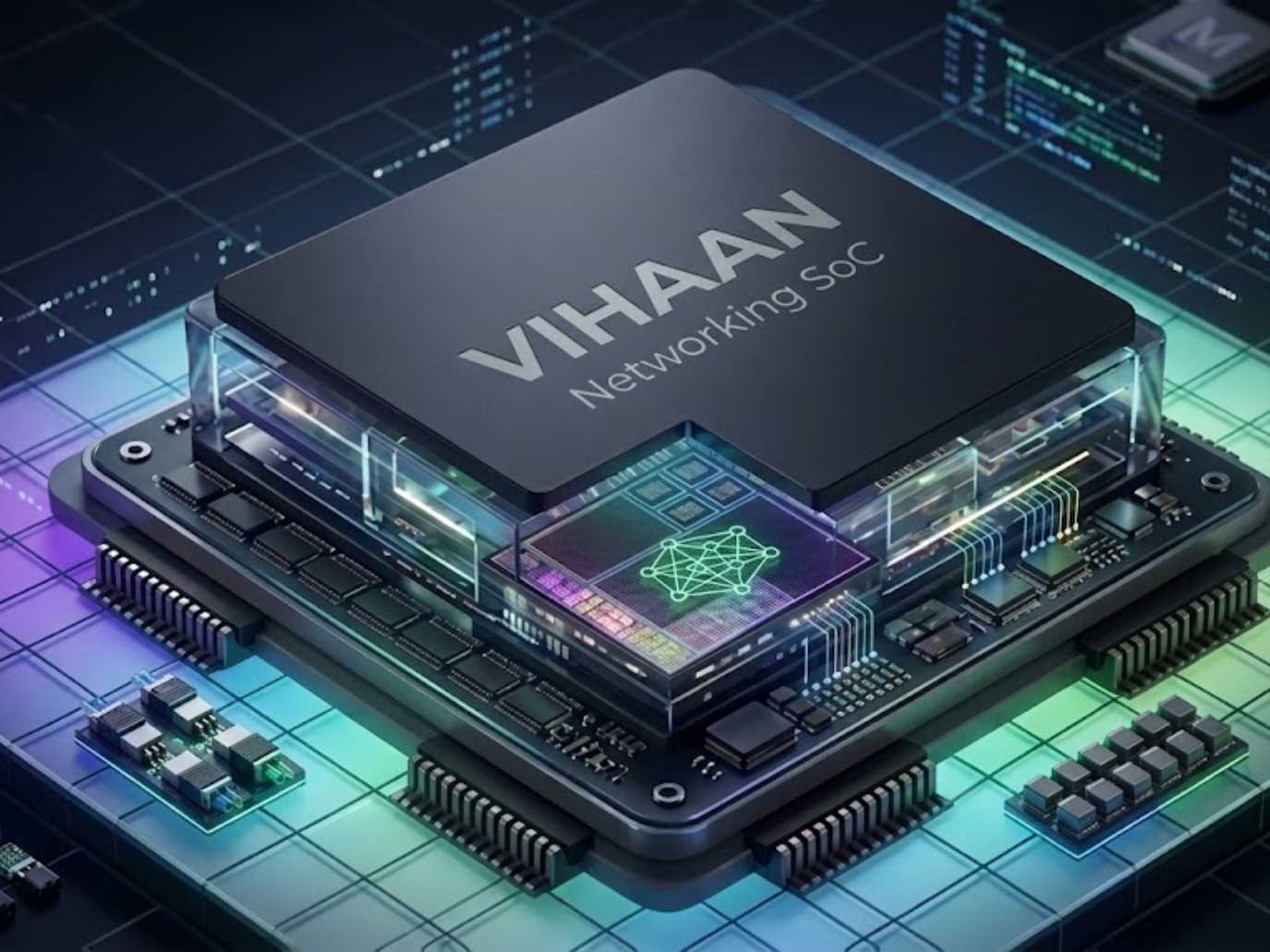
The Chennai-based fabless semiconductor company has achieved first-pass silicon success with VIHAAN, its broadband networking system-on-chip built around C-DAC’s 64-bit VEGA RISC-V processor. The timing has its own symbolism: VIHAAN was taped out on Republic Day 2026 and cleared first-pass silicon validation on Independence Day 2026. The chip, fabricated on a 28-nanometre process, now moves toward production tape-out targeted for 2027.
What “First-Pass Silicon Success” Actually Means
Tape-out is the point where a final chip design gets sent for fabrication, but it isn’t the finish line. The fabricated chip still has to be tested to confirm the physical silicon behaves as the design intended. If serious problems turn up, the design gets modified and fabricated again, often at significant cost and delay. A first-pass success means the very first fabricated version cleared that validation stage without needing another silicon revision, a genuinely difficult thing to pull off, and a real signal that Aheesa’s design and verification process held up under real-world fabrication.
From Chip Design to Silicon Capability
This is where India’s semiconductor story is actually shifting. Indian engineers have played major roles in global chip development for decades, but having engineers who can design chips is a different capability than having companies that can carry their own architecture through design, verification, tape-out, fabrication and silicon validation. VIHAAN represents real progress along that chain. It doesn’t mean India has become self-sufficient across the semiconductor value chain, but it does mean another Indian company has demonstrated it can move from a domestic architecture to working, validated silicon.
Why the VEGA Connection and Broadband Focus Matter
VIHAAN runs on C-DAC’s VEGA processor, built on RISC-V, an open instruction-set architecture that lets companies build processors without proprietary licensing constraints. Aheesa’s founder, Sridharan Mani, has been direct about why this mattered beyond cost: networking is fundamentally about security, and building on a domestic core means trust in every component, rather than relying on chips inside customer-premises equipment that are typically imported today. That’s a genuinely different argument than the usual “cheaper to build locally” pitch; it’s a sovereignty argument, made by someone who evaluated the alternatives and chose accordingly.
The chip’s target application, fibre broadband networking, including GPON/EPON systems that connect homes and offices, puts it close to core digital infrastructure. A single optical line terminal can support up to 128 optical network units, each potentially built using VIHAAN alongside Aheesa’s Seshnag reference platform, giving Indian equipment makers a genuine domestic silicon option where none existed before.
Manufacturing Insight: One Chip Doesn’t Make an Industry
The Design Linked Incentive (DLI) scheme backing Aheesa matters less for the subsidy itself and more for what it’s building at scale. According to the government, DLI-supported companies have collectively achieved more than 30 chip design tape-outs across various foundries and raised over $100 million in venture capital. That repetition is the actual point; one successful chip doesn’t create an industry, but dozens of companies working through tape-outs, fabrication, testing and commercialisation do. It builds specialised engineers, reusable IP, investors who understand semiconductor-specific risk, and suppliers who understand the development cycle. VIHAAN is one data point in that larger pattern, not a standalone win.
It’s also worth being honest about what’s still ahead. First-pass silicon success isn’t commercial success; VIHAAN still needs further validation, production preparation, OEM integration and real market adoption, and it will ultimately have to compete on performance, power consumption, cost, software support and availability, not just on being domestically designed.
The Ripple Effect
If companies like Aheesa successfully commercialise domestic semiconductor designs, the impact extends across the electronics manufacturing ecosystem. OEMs and ODMs gain a genuine local silicon option for broadband equipment instead of defaulting to imported chips. Embedded-systems companies get a domestic processor platform to build products around. Testing and validation labs see growing demand as more Indian-designed chips need qualification. Packaging and fabrication partners gain another customer moving through the tape-out cycle. And software developers get a reason to build and optimise for RISC-V-based Indian silicon, deepening the ecosystem around it.
Beyond the Headline
The bigger story here isn’t that one chip passed one test. It’s that India is slowly building the capability to move semiconductor ideas through the genuinely difficult middle of the development cycle, from a domestically developed processor to a domestic SoC to fabricated silicon to validation and eventually, if commercialisation succeeds, into real broadband infrastructure. India’s semiconductor ambition won’t ultimately be measured by how many chip designs get announced. It’ll be measured by how many of them make it into real products and real supply chains, and VIHAAN has just cleared one of the harder steps on that path.