
Indian auto Q1 FY27 was a volume festival. Industry production ran 19.4% higher year on year, with two-wheelers up 21%, commercial vehicles up 19.5% and passenger vehicles up 11.3%, and retail hit an all-time monthly high of 2.59 million units in July. The results that followed carried record after record: Maruti’s revenue up 36%, Bajaj Auto’s profit up 46%, TVS Motor’s up 67%. On the surface, a rising tide lifting every maker in the sector.
Read the profit lines next to the revenue lines, though, and the tide turns out to have been selective.
Manufacturing Tales Take
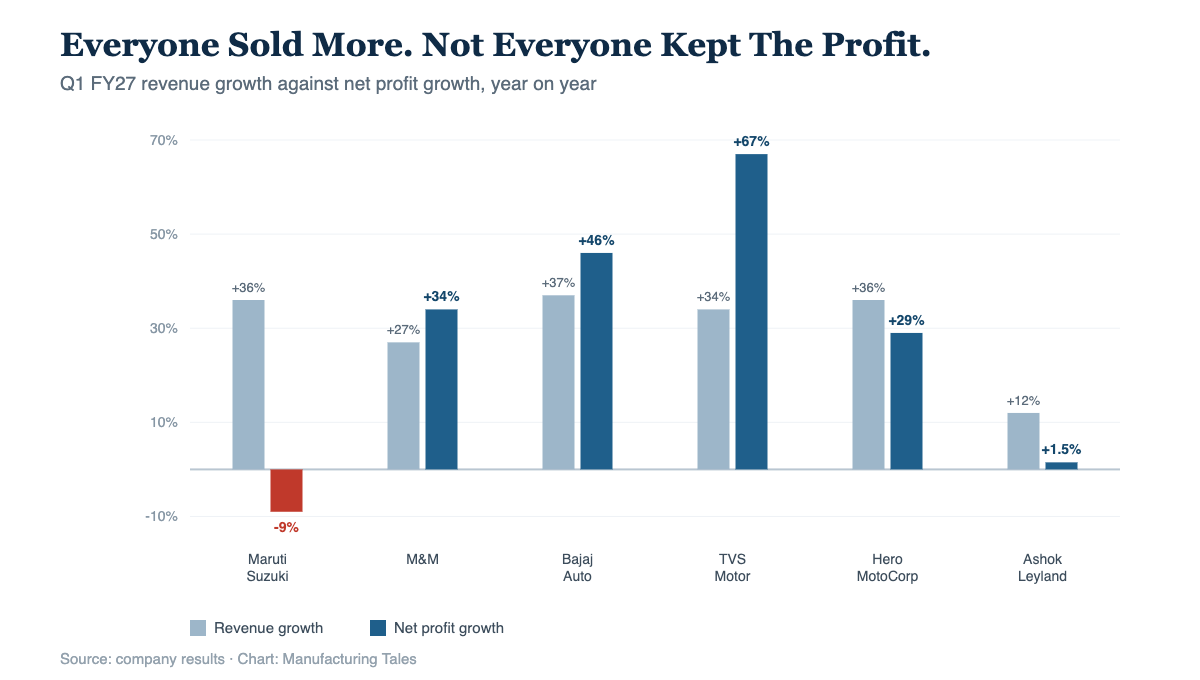
For years the shorthand on Indian auto was that it moves as one cycle: demand rises, everyone benefits; demand falls, everyone suffers. This quarter broke that. Every OEM sold more. The split came in who kept the money, and the dividing line was pricing power, not demand.
| Company | Segment | Revenue (YoY) | Net profit (YoY) | Margin / mix |
|---|---|---|---|---|
| Maruti Suzuki | Passenger vehicles | +36% | −9% | EBITDA 8.9% vs 11.6%; small-car squeeze |
| M&M | SUV / tractor | +27% | +34% | Core tractor PBIT 19.2%; SUV pricing power |
| Bajaj Auto | 2W / 3W | +37%* | +46% | Operating margin >20%; exports +52% |
| TVS Motor | 2W / 3W | +34% | +67% | e2W volumes +82% |
| Hero MotoCorp | 2W | +36% | +29% | EBITDA 13.3% vs 14.4%; mass-market |
| Ashok Leyland | Commercial vehicles | +12% | +1.5% | Volume without pricing |
Commodity inflation of around 3.5% in the quarter hit all of them equally. Only some had the product mix to pass it on.
Where The Squeeze Landed
Start with the squeezed end, because the country’s largest carmaker is sitting in it. Maruti grew revenue 36%, lifted volumes 29% and added 2.3 points of market share to reach 41.2%, and its profit still fell, because raw material costs climbed almost 46% and a small-car buyer will not absorb a price hike to match. That is the whole problem with the volume end of the market: the customer is price-elastic, so input inflation lands straight on the margin. Ashok Leyland told the same story in commercial vehicles, growing revenue in double digits while profit barely moved. Even Tata Motors’ commercial vehicle arm, which reported an 83% profit jump, saw its underlying EBITDA margin slip, with the headline flattered by a mark-to-market gain on its Tata Capital holding rather than by the business itself.
Where Pricing Power Held
Now the other end, where the product does the pricing. Mahindra held a core tractor margin above 19% despite the same commodity pressure, because a Thar or Scorpio-N buyer waits months and pays up. Bajaj Auto kept operating margins above 20%, carried by a 52% surge in exports and a premium-plus-EV mix. TVS lifted profit 67% with electric two-wheeler volumes up more than 80%. Hero MotoCorp, the volume commuter leader, grew profit 29% on a 23% jump in units, but its margin still eased, a reminder that even a strong two-wheeler franchise feels the squeeze when the mix leans mass-market. Differentiated product, whether premium, export or electric, let a maker carry the input cost. Commodity product did not.
What To Watch In Q2
There is a forward wrinkle worth flagging for the next quarter. The GST rationalisation and income-tax relief coming into Q2 are expected to lift volumes again across the board. That will flatter every topline and, if this quarter is any guide, once more disguise the margin divergence underneath. The monsoon is the swing factor on the tractor leg that has been doing so much of Mahindra’s heavy lifting. Volume tailwinds are the easy part to forecast. Whether they convert to profit is the question that separates these names.
Why This Matters
The lesson runs past auto. In a quarter of broad commodity inflation, volume turned out not to be the moat. Mix and pricing power were. The makers who owned a product the customer would wait for, or pay a premium for, or buy for its technology, passed their cost increases through and grew profit. The makers who move metal at competitive prices grew revenue and watched the margin go.
That is a manufacturing signal as much as a financial one. It tells you where the capital should go: up-market, toward exports, toward electric and differentiated platforms, and away from pure volume plays whose economics are set by steel and aluminium prices they do not control. India’s auto industry is quietly separating into a pricing-power tier and a pass-through tier. The volume numbers put everyone in the same headline. The margin numbers are where you find out which tier a company is actually in. The same divergence showed up in auto component suppliers and, in a different form, across specialty chemicals and cement this quarter.