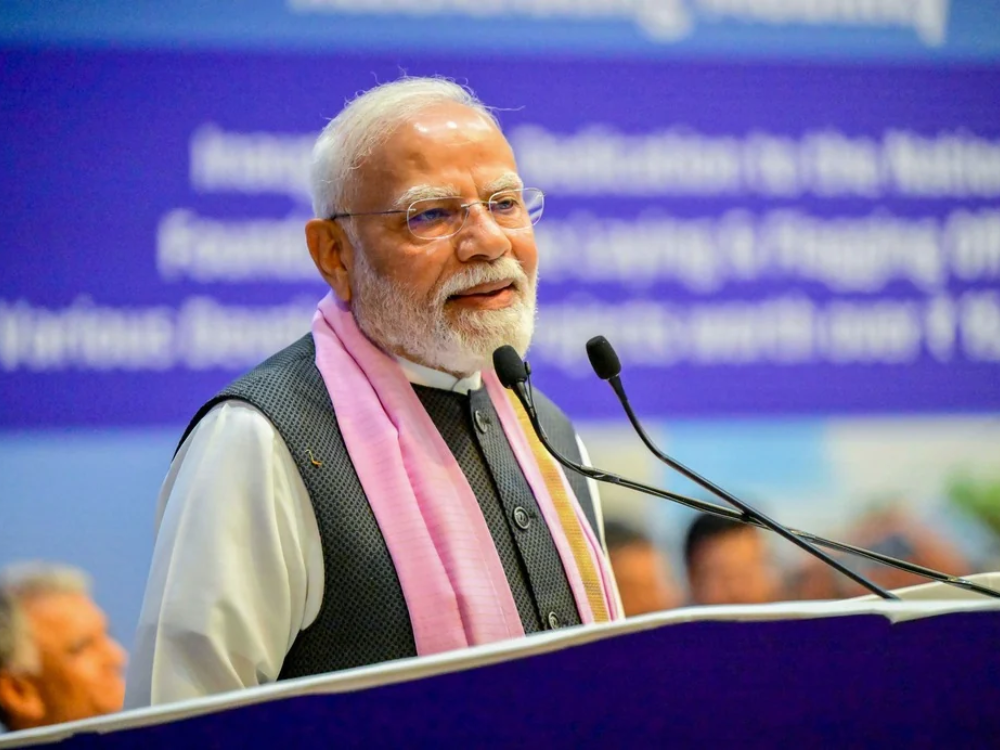

According to a press release issued by the Press Information Bureau (PIB), Prime Minister Narendra Modi inaugurated, dedicated to the nation, laid the foundation stone and flagged off development projects worth over ₹15,600 crore in Bengaluru, Karnataka.
The projects cover key areas, including metro and rail connectivity and energy security, with the aim of strengthening the state’s infrastructure and supporting its economic growth.
Addressing the gathering, the Prime Minister highlighted the role of infrastructure and improved connectivity in creating opportunities for employment, industrial development and economic progress. He said better connectivity helps strengthen the fight against poverty by ensuring that development opportunities reach all sections of society.
The Prime Minister also dedicated the new Pink Line of Bengaluru Metro, which is expected to improve connectivity to IIM Bengaluru, educational institutions and major business, technology and commercial centres across the city. He noted that Bengaluru has become the third city in India, after Delhi-NCR and the Mumbai Metropolitan Region, to achieve a 100-km metro network.
Describing the Namma Metro expansion as an important step towards improving ease of living and ease of travel, PM Modi said the new corridor would help commuters save time and money.
He also highlighted recent railway developments in Karnataka, including the state’s first Vande Bharat Sleeper train and a newly dedicated Vande Bharat service connecting Karnataka with Goa.
The Prime Minister further emphasised India’s ambition to become a global leader in emerging technologies, including semiconductors, artificial intelligence, data centres and quantum computing.
The projects are expected to strengthen Karnataka’s infrastructure and support the state’s contribution to the vision of Viksit Bharat.
Describing Bengaluru as the Silicon Valley of India that contributes over one-third of the nation’s IT exports and serves as a major engine of innovation and economic growth, the Prime Minister stated that the Central Government has prioritized the rapid development of the Bengaluru region and expanded Namma Metro from just 17 kilometers in 2014 to over 100 kilometers today, making Bengaluru the third Indian city after Delhi-NCR and the Mumbai Metropolitan Region to cross the 100-kilometer metro milestone. “This success of Namma Metro is the result of the country’s new thinking regarding Ease of Living and Ease of Travel, and the outcome of the country’s commitment to make the lives of middle-class families better,” asserted Prime Minister Modi.
Stating that Indian Railways is shedding its colonial-era mindset to build a new legacy where stations, engines, and coaches bear India’s distinct identity through Vande Bharat trains and Amrit Bharat stations, including over 60 stations in Karnataka alongside Chamarajanagar, Chikkamagaluru, Sakleshpur, and Subrahmanya Road, the Prime Minister highlighted how these stations blend modernity with sensitivity by offering special amenities for senior citizens and Divyangjans. “The facilities that were earlier found in airports, efforts are now being made to provide those very facilities at railway stations to poor and middle-class families,” noted PM Modi.
Pointing out that India’s railway budget has grown manifold over the past 10 to 12 years with a ninefold increase in Karnataka’s allocation, the Prime Minister noted that the state received four Amrit stations and two doubling and electrification projects today, alongside a new Vande Bharat train connecting Karnataka with Goa just days after receiving its first Vande Bharat Sleeper train. “Through this train, companions along the entire coastal route of Karnataka, including Mangaluru, will get a new experience of a semi-high-speed train,” observed PM Modi.
Underscoring that the ongoing war around Iran and the Gulf region has demonstrated the vital importance of energy security, the Prime Minister explained that India weathered this challenging period firmly due to steps taken over the past decade, expanding petrol, diesel, and LPG production, crude oil storage, solar, hydro, and wind energy, near-total rail electrification, and metro networks, and detailed three new Karnataka projects: the Mangaluru LPG Project adding 80,000 metric tonnes of storage capacity, the Devangonthi Marketing Terminal streamlining petrol, diesel, and aviation fuel supply, and the Bengaluru CBG plant producing 13 tonnes of biogas daily. “This will improve waste management and money spent on the import of natural gas will also be saved,” noted PM Modi.
Highlighting that reliable electricity generation is essential as India strives for global leadership across new technologies from chips to ships and from AI and data centers to quantum computing, the Prime Minister noted that the nation is expanding its nuclear power plants to achieve clean energy goals. “Today India’s renewable energy capacity has exceeded 300 gigawatts,” observed PM Modi.
Pointing out that Central schemes are transforming Indian citizens from electricity consumers into electricity producers, the Prime Minister noted that over 60 lakh households nationwide, including more than 40,000 families in Karnataka, have installed rooftop solar plants with Central assistance of around 80,000 rupees per family under the PM Surya Ghar Muft Bijli Yojana, while irrigation through over 8 lakh solar pumps is being arranged for Karnataka’s farmers under the PM KUSUM Yojana to cut power costs and generate new income and jobs. “Meaning, the Annadatas of Karnataka are now also becoming Urjadatas,” remarked PM Modi.
Observing that purposeful national execution, public participation, and proper utilization of taxpayer money under the post-2014 resolve of Sabka Saath, Sabka Vikas have expanded the middle class and created a new Aspirational Class seeking home appliances, two-wheelers, quality education, nutrition, healthcare, and tourism experiences, the Prime Minister pointed out that these rising aspirations are driving new industrial and job growth across automobiles, electronics, tourism, and services, making the Neo Middle Class a major engine of India’s economic growth. “The interest of this Neo Middle Class, which is present in large numbers in Karnataka and in Bengaluru as well, is among the priorities of the Central Government,” affirmed PM Modi.
Stating that the Central Government is working continuously to boost middle-class savings and put more disposable income in their hands, the Prime Minister highlighted measures such as exempting annual income up to 12 lakh rupees from income tax, revising TDS rules to benefit senior citizens and rental earners, and lowering the cost of everyday goods through next-generation GST reforms. “By abolishing GST on personal health and life insurance, we made insurance more affordable,” noted PM Modi.
Concluding his address by stating that today’s projects in Karnataka will further accelerate the nation’s developmental trajectory and extending his best wishes to the people, the Prime Minister emphasized the government’s commitment to empowering middle-class families. “Our effort is that the savings of the middle class increase, their purchasing power becomes strong, and along with fulfilling the dreams of their family, they also become partners in the economic progress of the country,” affirmed PM Modi.
Source: Press Information Bureau (PIB)