
There is a number in the machine tool industry’s latest data release that ought to stop the reindustrialisation conversation in its tracks.
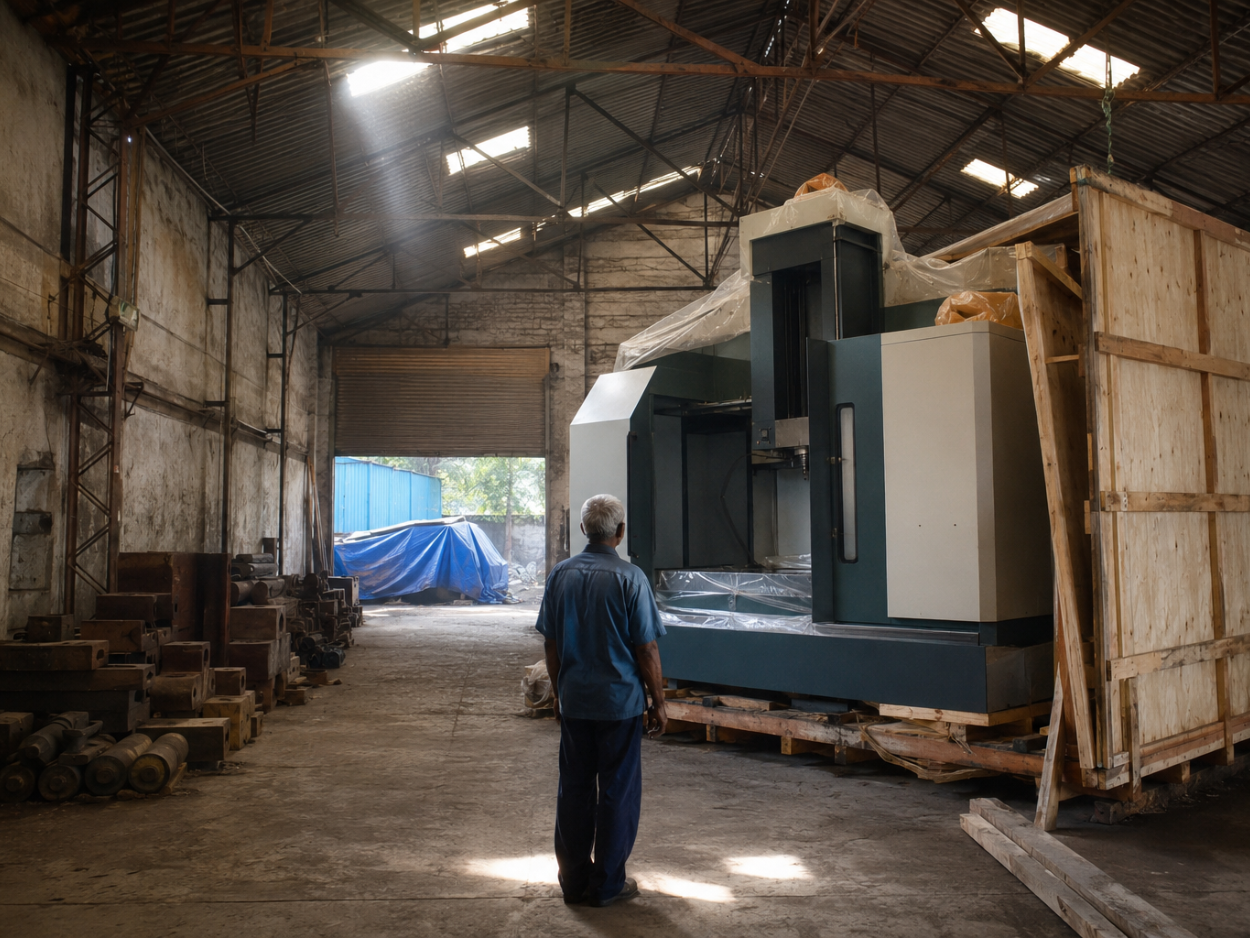
In FY26, India built ₹17,387 crore worth of machine tools. It imported ₹21,628 crore worth. For the first time in a boom year, the country bought more of its means of production from abroad than it made at home.
Both numbers are records. Domestic production rose 19%, the strongest year IMTMA has recorded. Consumption crossed ₹35,000 crore for the first time, reaching ₹36,419 crore. Exports jumped 76%. Every headline in that release is good news, and taken together they describe a problem nobody has a scheme for.
This is India’s import paradox. When Indian factories do well, they buy machines. Roughly 59% of that spending leaves the country. The better the manufacturing sector performs, the wider the capital goods gap becomes. Success and dependence are moving in the same direction, and the second is moving faster.
(This piece takes its starting point from an essay by Maahir Panchal, founder of Titan Additive, who wrote recently that India is “a nation of job shops that never became a nation of companies.” The data below is our own.)
Where the machines come from
The single largest source of India’s imported machine tools is China, at 30%, ahead of Japan at 21% and Germany at 12%. India ran a $112 billion trade deficit with China in FY26, the year China displaced the United States as India’s largest trading partner for the first time in four years.
So the equipment that will cut Indian parts for the next fifteen years is, more often than not, bought from the country India’s industrial policy is designed to reduce dependence on. India now ranks fourth in the world in machine tool consumption and ninth in production. Large customer, small supplier.
No industrial power has ever skipped this layer. China was the world’s largest machine tool importer through the 1990s, sitting exactly where India sits now. It became the largest producer in 2009 and a net exporter in 2021. Japan overtook the United States in 1982, two decades into its high-growth era, not ahead of it. In both cases the tooling base was built alongside the manufacturing rise, never after it.
India has tried. The National Capital Goods Policy of 2016 set a target of ₹7.5 lakh crore of capital goods production by 2025. Actual production in 2023-24 was ₹4.29 lakh crore. The target was missed by more than 40%, and it passed without much comment.
What replaced it is smaller than the problem. The Capital Goods Scheme Phase II carries a total outlay of ₹1,207 crore, of which ₹975 crore is budgetary support, spread across 32 sanctioned projects. The mobile phone assembly scheme notified last week carries ₹62,500 crore. India Semiconductor Mission 2.0, cleared in July, carries ₹1.25 lakh crore.
Set those three numbers beside each other and you have the industrial policy stated more plainly than any speech will state it. India is funding the factories and not the machines that fill them.
The exception that proves it can be done
Jyoti CNC in Rajkot is what the alternative looks like. FY26 standalone revenue of ₹1,949 crore. An order book of ₹4,732 crore at year end, with aerospace and defence accounting for 38% of it. Capacity moving from 6,000 machines a year to 16,000 around September, a ₹426 crore expansion decided in a boardroom in Gujarat rather than announced from a podium.
LMW’s machine tool and foundry segment grew 20% in FY26 to ₹1,205 crore, with segment profit up 64%. Ace Micromatic has just opened a plant near Ahmedabad targeting 4,000 machines a year and has set itself a $1 billion revenue goal by 2030.
These are real businesses growing fast. They are also, collectively, far too small to close a ₹21,628 crore import bill. And beneath them sits the tier almost nobody in India funds at all: spindles, linear guideways, ballscrews, encoders, CNC controllers, carbide tooling. Open an Indian-built machine and read the component labels. There is no published figure for how much of that subsystem layer is imported, which is itself revealing. Nobody measures it because no scheme targets it.
The same pattern, one industry over
Electronics tells the identical story at ten times the scale.
Smartphones were India’s single largest export product in FY26 at $29.36 billion, ahead of automotive diesel. iPhone exports alone crossed ₹2 lakh crore, and India assembled roughly 55 million iPhones in calendar 2025, about a quarter of Apple’s global output, up from 36 million a year earlier.
Now the other column. Electronics imports hit $116.17 billion in FY26 against $48 billion of exports, a deficit of around $68 billion and the first year imports crossed $100 billion. Domestic value addition in mobile manufacturing runs at 15% to 20%; ICEA’s own estimate is 18% to 20%. China sits at 38% to 40%.
The sharpest number is this one: components accounted for roughly 9% of India’s electronics production in 2023-24, against a global benchmark closer to 42%. India has built the assembly floor and imported the industry that supplies it.
To the government’s credit, this is now recognised. The Electronics Components Manufacturing Scheme has approved 106 applications carrying ₹69,548 crore of committed investment, and its outlay was raised from ₹22,919 crore to ₹40,000 crore in the last Budget. The new mobile scheme offers up to 1.5% extra for localising displays, cameras, batteries and connectors. The direction is right. The test is whether a 1.5% sweetener is enough to make display fabrication viable in India, and whether the money actually moves.
Why the money doesn’t move
It mostly doesn’t. Against a total PLI outlay of ₹1.97 lakh crore across 14 schemes, ₹28,748 crore had been disbursed as of December 2025 — about 15%. The ₹18,100 crore advanced chemistry cell scheme has disbursed nothing at all, has been pushed out to 2031, and has 1.4 GWh operational against 40 GWh awarded.
An outlay is a budget line. A disbursement is money a manufacturer can use to buy equipment. India reports the first with the enthusiasm the second would deserve, and a shop owner deciding whether to expand has no published median disbursement lag to plan against. He guesses, and guessing conservatively means not expanding.
That is compounded by what capital costs him. The RBI’s repo rate sits at 5.25%. An MSME financing a machining centre pays somewhere between 8% and 20%. At 12% over five years against a Taiwanese or Japanese competitor financing the identical machine at low single digits over fifteen, the two businesses are not comparable, whatever the spindle does. Cost of capital sets the technical ceiling of a manufacturing base. It decides whether a shop buys three-axis or five-axis, new or used, current generation or one behind.
What isn’t compounding
The consequences show up in the structure of the sector.
The Economic Survey of 2018-19 identified what it called dwarfs: firms with under 100 workers that are more than ten years old. They are over half of all organised manufacturing firms by number, yet deliver just 14% of employment and 8% of productivity. Firms above 100 employees are about 15% by number and carry three-quarters of employment and close to 90% of productivity. The Annual Survey of Industries counted 2,60,061 operating factories in 2023-24 employing 1.96 crore people. The bulk of them are stuck.
Two more numbers complete the picture. Manufacturing employs 12.1% of India’s workforce while agriculture still employs 43%, so the transition out of farming is going to services and construction rather than to factories. And manufacturing is about 16% of gross value added, against the 25% Make in India target set a decade ago.
The workforce constraint is real but misdiagnosed. Only 46.9% of sanctioned ITI trainer posts are filled and only 18.4% of trainers hold Craft Instructor Training Scheme certification. Capacity crossed 23 lakh seats by 2022 while enrolment was about 13.3 lakh in 2024. On PLFS data, just 4.1% of Indians aged 15 to 59 have formal vocational training. PM-SETU commits ₹60,000 crore to upgrade 1,000 ITIs, and the risk is that India ends up with excellent buildings and empty staff rooms, because anyone qualified to teach CNC programming earns several times a trainer’s salary doing it.
Then there is research. India spends 0.84% of GDP on R&D against China’s 2.58% and South Korea’s 4.94%. One genuinely encouraging shift: in FY24 the private sector overtook government R&D spending for the first time, at 51.8% of a ₹2.45 lakh crore total. That is the right direction from a base one third the intensity of the country India competes with.
What we would do
The base is not weak. Defence exports hit ₹38,424 crore in FY26. Engineering goods crossed $122 billion, 28% of merchandise exports. The first Made-in-India C295 rolled out of Vadodara in May, four months early. Skyroot put Vikram-1 into orbit on 18 July. Manufacturing GVA grew 10.7% last year and capital goods output was up 14.2% in June.
What is missing is the arrangement that lets any of it multiply. Four things would change it.
Fund the machine tool and component tier at the scale India funds fabs. A ₹1,207 crore scheme against a ₹21,628 crore import bill is not a policy, it is a gesture.
Publish a disbursement clock. One median lag figure per scheme, updated quarterly, so manufacturers can price delay into their plans instead of assuming the worst.
Underwrite equipment rather than applicants. A machine has a serial number and a resale market, which makes it better collateral than a business plan, and lending against it needs no selection committee.
Build the cluster commons. Metrology labs whose certificates a European buyer accepts without argument, real furnace mapping, NDT, materials testing. Fix that in twenty clusters and the technical ceiling of ten thousand firms rises without any of them borrowing a rupee.
India spent the last decade proving it can assemble at world scale. The next decade is about whether it can build what does the assembling. On current numbers, that gap is widening in the years the sector does well, which is the only time anyone can afford to close it.
Data sources: IMTMA (August 2026), Ministry of Commerce & Industry, PIB, MoSPI, RBI, DST Research & Development Statistics 2025-26, Annual Survey of Industries 2023-24, Economic Survey 2018-19, PLFS, ICEA, and company filings.