
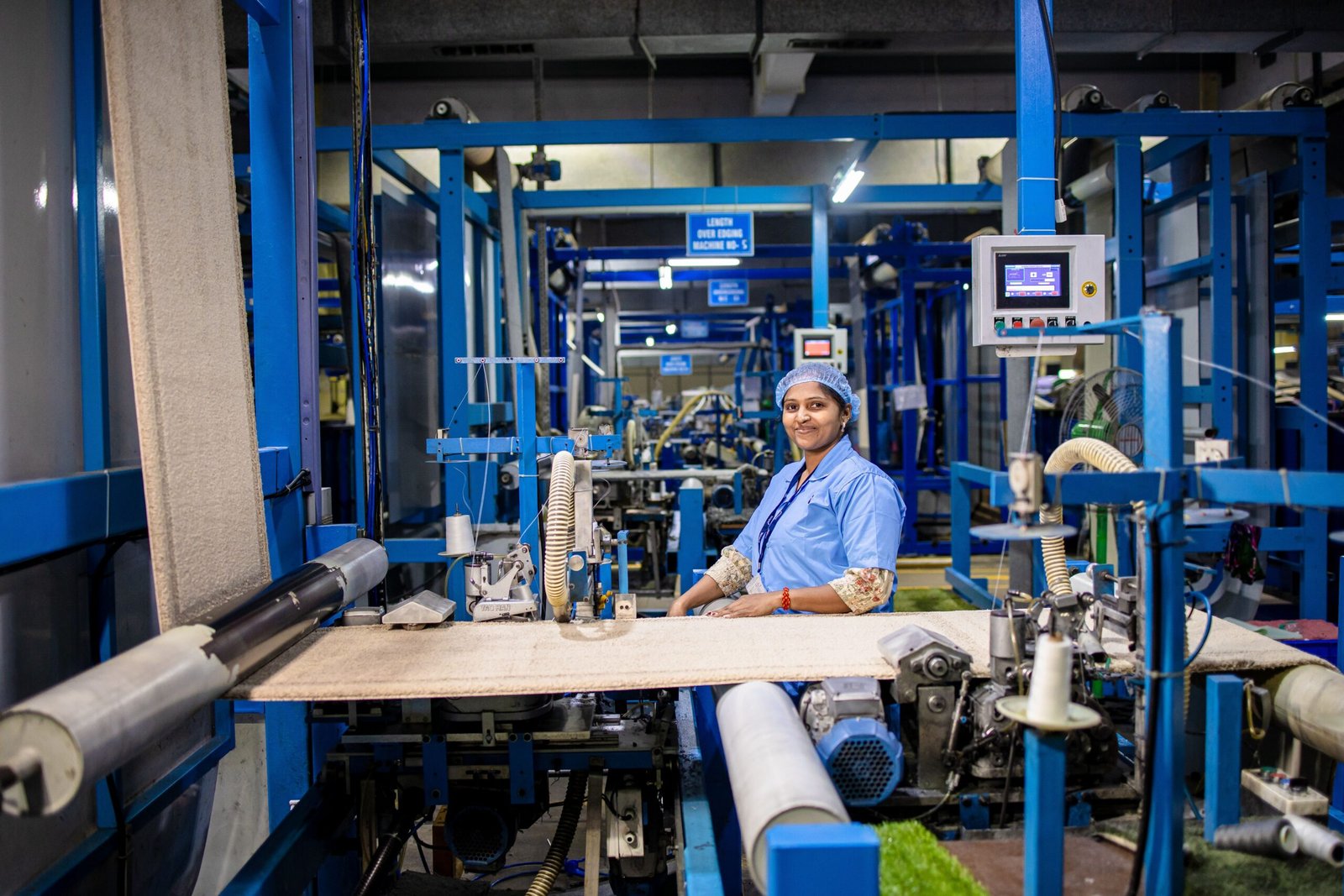
The MSME Amendment Bill 2026 has cleared both houses of Parliament.
Parliament has passed the Micro, Small and Medium Enterprises Development (Amendment) Bill, 2026 cleared by the Rajya Sabha on August 3 and the Lok Sabha on August 7, bringing the first major overhaul to the MSMED Act since it was originally notified in 2006. The bill now awaits Presidential assent before it takes effect. On the surface, this reads like routine legislative housekeeping: a 20-year-old law getting updated for a changed economy. For India’s manufacturing MSMEs specifically, though, the amendment touches something far more immediate than compliance paperwork. Cash flow, dispute resolution, and the basic financial predictability that these factors determine whether a small manufacturer can commit to a larger order in the first place. And this bill affects all of these aspects.
What the Bill Actually Changes
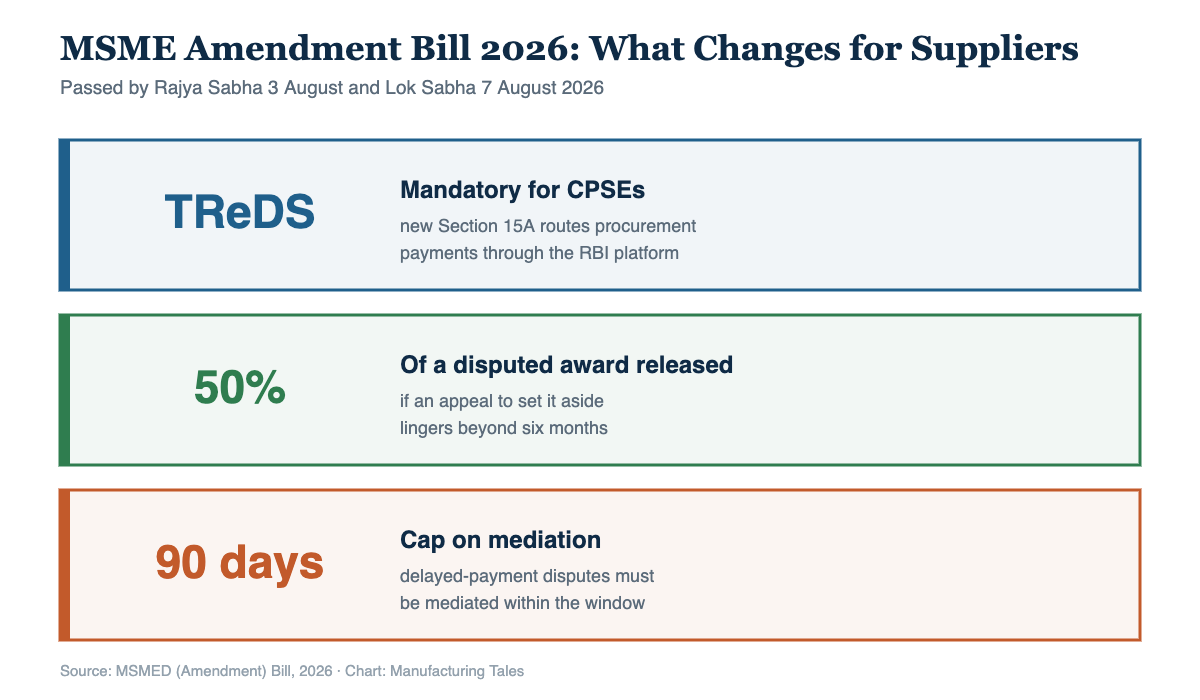
The amendment’s most consequential provision addresses a problem that has quietly strangled working capital across India’s manufacturing MSME base for years: delayed payments. The bill inserts a new Section 15A requiring every Central Public Sector Enterprise to route procurement payments to MSME suppliers through the Trade Receivables Discounting System (TReDS), an RBI-regulated electronic invoice-financing platform, with government empowered to extend this requirement to other public entities as well (PRS India, Bill Track). The amendment also requires that in payment disputes, courts must direct release of at least 50% of a disputed awarded amount to micro and small enterprise suppliers if an appeal to set aside the award lingers past six months, and mandates that mediation of such disputes be completed within 90 days.
Alongside the payments fix, the bill reworks how MSMEs are classified, anchoring classification to the twin criteria of investment in plant and machinery (or equipment) and turnover, while removing fixed thresholds from the Act itself and empowering the central government to notify them by regulation instead, allowing classification to be updated as the economy evolves without requiring fresh legislation each time. The bill also gives statutory permanence to the Udyam Registration Portal as a free, voluntary digital registration system relevant given Udyam-registered enterprises have grown from 1.65 crore in April 2023 to 9.16 crore today (PIB Press Release). On the compliance side, minor registration or reporting defaults move from criminal-style penalties toward a graded administrative framework, a warning on first contravention, followed by rising monetary fines replacing what industry groups have long flagged as disproportionately punitive treatment for small, often unintentional lapses.
Why Cash Flow Is the Real Manufacturing Story Here
For a services MSME, a delayed payment is a cash-flow headache. For a manufacturing MSME, it can be the difference between running a production line and idling one. Manufacturing businesses typically carry heavier upfront costs, raw material procurement, machine time, and labour scheduled around a production run, long before an invoice gets paid. When a large buyer, particularly a public sector enterprise with substantial negotiating leverage, delays payment by weeks or months, the MSME supplier is effectively financing that buyer’s working capital with its own, often thin, margins.
This is precisely why the TReDS mandate matters more to manufacturers than it might first appear. TReDS allows an MSME to discount its unpaid invoice and receive cash upfront from a financier, rather than waiting out the buyer’s payment cycle. Making this mandatory for CPSE procurement, rather than optional, as it has effectively been removes a chronic point of financial uncertainty that has made many manufacturing MSMEs reluctant to bid for larger, public-sector-linked contracts in the first place.
Manufacturing Insight: Formalisation Is the Precondition for Scale
There’s a pattern worth naming here, because it connects this bill to almost every other manufacturing story India has produced this year, defence production crossing ₹1.7 lakh crore, semiconductor packaging facilities breaking ground, battery storage capacity doubling, integrated rail manufacturing platforms taking shape. Every one of these larger manufacturing programmes depends on a deep base of MSME suppliers capable of reliably feeding into them. And that reliability depends on something more basic than technical capability: financial stability.
An MSME that can’t predict when it will get paid cannot confidently invest in new machinery, hire additional skilled workers, or commit capacity to a larger OEM’s production schedule. It ends up structurally risk-averse, bidding conservatively, keeping order books shallow, and avoiding the kind of capital investment that would let it move up the value chain. The classification reform and Udyam permanence in this bill matter for a related reason: as India’s manufacturing base scales toward more complex, higher-value production semiconductor packaging, precision components, battery systems. A flexible, digitally-anchored classification system makes it easier for policy and credit access to keep pace with how fast individual MSMEs are actually growing, rather than trapping them in outdated investment slabs.
Put together, this amendment isn’t primarily a manufacturing policy; it’s a financial infrastructure policy. But manufacturing MSMEs, given how capital-intensive and cash-flow-sensitive their operations tend to be, may be its most direct beneficiaries.
The Ripple Effect
If this amendment achieves what it’s designed to, its effects are likely to extend well beyond the immediate question of who gets paid on time.
Component and precision-part suppliers to large OEMs in automotive, defence, electronics and rail manufacturing, stand to gain the most directly, since faster, more predictable payment cycles make it commercially viable for smaller manufacturers to take on larger orders without over-extending working capital.
TReDS platform operators and invoice-financing institutions are likely to see a meaningful uptick in volume as CPSE-linked procurement is routed through the system by mandate rather than by choice, expanding the addressable market for invoice discounting in India.
Banks and NBFCs focused on MSME lending may find improved risk visibility, since more predictable, digitally tracked payment cycles through TReDS and Udyam give lenders better data to underwrite working-capital loans, potentially easing one of the oldest complaints in Indian manufacturing: that small manufacturers struggle to access credit despite having viable, order-backed businesses.
Legal and dispute-resolution service providers working with MSMEs are likely to see rising demand for support navigating the new 90-day mediation timelines and Online Dispute Resolution mechanisms, particularly as more MSMEs become aware of and willing to exercise these rights.
Larger OEMs and public sector buyers face a more immediate compliance shift, needing to restructure procurement and payment workflows around mandatory TReDS routing, a change that, while an adjustment, could ultimately strengthen supplier relationships and reduce disruption risk in their own supply chains.
Industry associations and MSME advocacy bodies, such as FISME, are likely to play a larger role translating these provisions into practical guidance for members, particularly around Udyam registration, classification changes, and understanding the new decriminalised penalty framework.
Manufacturing Takeaway
Legislative amendments rarely make for dramatic headlines, and this one is no exception, it passed amid parliamentary noise over an entirely unrelated political dispute, which likely means most of its substance went unnoticed outside specialist coverage. But for India’s manufacturing MSMEs, the practical effect of this bill may matter more than several higher-profile industrial announcements this year, precisely because it targets the unglamorous financial plumbing, payment cycles, dispute timelines, classification clarity that determines whether a small manufacturer can actually scale into the supply chains that headline-grabbing projects depend on.
India’s manufacturing ambitions, from semiconductors to defence to rail, all rest on a deep, financially stable base of MSME suppliers. This bill is a direct attempt to strengthen that base. Whether it succeeds will depend less on the text of the law and more on how consistently TReDS mandates, faster dispute resolution and simplified classification actually get implemented on the ground over the next few years.