
The India capital goods order book says the long-awaited investment cycle has arrived. Siemens went into the year with a record backlog near ₹45,030 crore. L&T’s group order inflow crossed ₹1 trillion in a single quarter, and Thermax’s order backlog hit a record ₹14,045 crore, up 23%, including a US data-centre order worth over ₹400 crore. On the demand side there is very little to argue with.
The order book says boom. The profit line says wait.
Manufacturing Tales Take
For a decade the complaint about Indian capital goods was thin order visibility. That has flipped. The constraint now is not winning the work; it is making money on it.
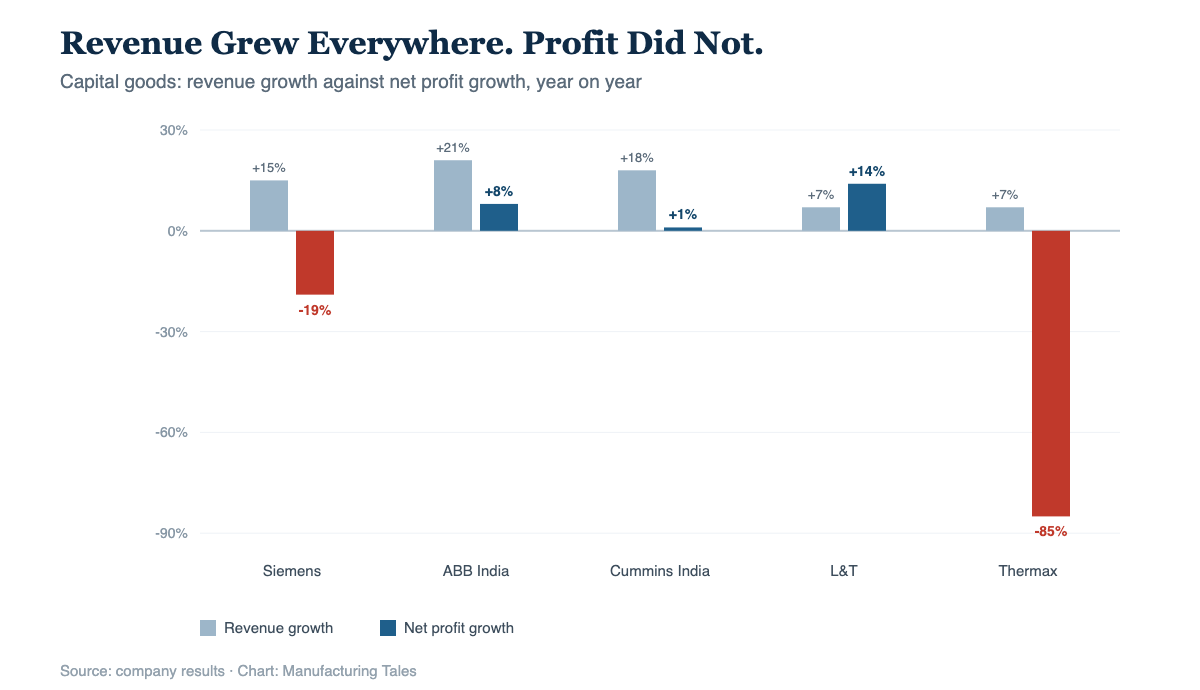
| Company | Revenue (YoY) | Net profit (YoY) | Margin | Demand signal |
|---|---|---|---|---|
| Siemens | +15% | −19% | EBITDA 9.1%, −345 bps | Backlog ~₹45,030 cr |
| ABB India* | +21% | +8% | Op 12.7% vs 13.8% | Record orders, data centres |
| Cummins India | +18% | +1% | EBITDA ~18% | DCs ~35% of power-gen revenue |
| L&T | +7% | +14% | Stable | Order inflow +14%, >₹1 trn |
| Thermax | +7% | −85% | Hit by ₹91 cr overrun | Order book +23% to ₹14,045 cr |
Read down the profit column and the pattern is unmistakable. Revenue grew everywhere. Profit did not. Siemens and Thermax show the two ways a strong order year still produces a weak quarter: metal inflation grinding the margin on fixed-price work in the first case, a single legacy-project cost overrun in the second. Even the healthy names, ABB and L&T, grew profit far more slowly than their order books would suggest.
Why A Fat Backlog Is Not Locked-In Profit
The mechanism is where the cycle gets decided. A capital goods order is often a fixed price against a delivery that runs twelve to twenty-four months. You win it at today’s price and absorb whatever input inflation arrives before you ship, and copper rose double digits during the quarter. A fat backlog booked in a rising-commodity environment is a deferred margin risk, not a locked-in profit. The order inflow figure is a revenue promise. It is not a margin one.
Data Centres Are The New Demand Pool
What is genuinely new is the demand pool underneath. Data centres and grid electrification, not the old government-infra story, are driving the record intake, from Cummins deriving roughly 35% of its domestic power-generation revenue from data centres to Thermax winning boiler pressure-part orders for a US data centre. That is the structural leg worth tracking, and it sits alongside the semiconductor and electronics build-out now drawing its own capital.
Why This Matters
The investment cycle India waited a decade to see is finally visible, and it shows up first in the order books, exactly where it should. But an order book is the easy thing to celebrate. This cycle will be judged on whether these firms convert record backlogs into margin while their input costs rise, or whether they have quietly locked in two years of low-margin revenue. The number that matters is in the margin column, not the order-inflow headline.
It is the same test Indian auto faced this quarter, and it runs against a backdrop where the RBI has raised its growth forecast while asking manufacturing to earn the margin that goes with it.