
India pharma CDMO and custom-synthesis names reported the June quarter and, read together, they settle an argument. The reshoring of drug manufacturing away from China is not a rising tide lifting everyone equally. It rewards a specific kind of company, and it punishes another.
The tailwind is intact. The lesson is about who catches it.
Manufacturing Tales Take
Two poles frame the quarter. At one end, the custom-synthesis and CDMO players posting some of the best numbers in Indian pharma. At the other, a marquee name in a net loss.
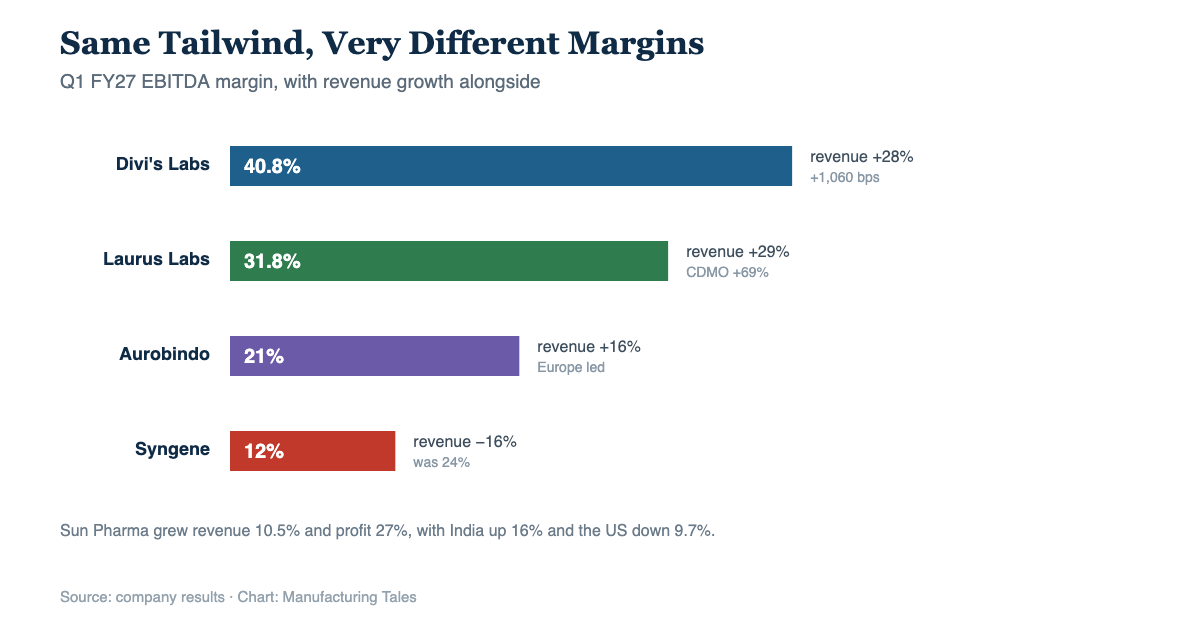
| Company | Revenue (YoY) | Net profit (YoY) | EBITDA margin | Driver |
|---|---|---|---|---|
| Divi’s Labs | +28% | +66% | 40.8%, +1,060 bps | Custom synthesis |
| Laurus Labs | +29% | +126% | 31.8% | CDMO sales +69% |
| Aurobindo | +16% | +25% | 21% | Europe, growth markets |
| Sun Pharma | +10.5% | +27% | Strong | India +16%, US −9.7% |
| Syngene | −16% | Net loss | 12% vs 24% | Lost anchor client |
The top of the table is the reshoring thesis working as advertised. Divi’s grew profit 66% with its EBITDA margin expanding more than ten points to nearly 41%, and Laurus more than doubled profit as its CDMO sales jumped 69%. These are diversified custom-synthesis books spread across many clients and platforms. The bottom of the table is the same thesis exposed from below: Syngene’s revenue fell 16% and its margin halved because a single large biologics client stopped taking offtake.
Concentration Is The Whole Difference
Reshoring flows are lumpy and contract-driven, so a book built on one or two anchor programmes is one customer decision away from a hole, which is precisely what happened. Divi’s and Laurus spread the risk; no single client can take their quarter down. The middle of the table, Sun and Aurobindo, points to why custom synthesis is the better place to be at all: Sun’s US formulation sales fell almost 10% and the US generics business remains under price pressure, while the CDMO and custom-synthesis names are riding a structural inflow rather than a price war. Capital spending confirms the conviction, with Laurus doubling FY27 capex to ₹2,000 crore to build commercial-scale capacity ahead of demand.
Why This Matters
China-plus-one in pharmaceuticals is not a tide that lifts every Indian manufacturer equally, and this quarter proved it. It rewards diversified client bases, commercial-scale capability and platform breadth, and it punishes concentration without mercy. Q1 FY27 drew that line about as sharply as one reporting season can, with Divi’s and Laurus on one side and Syngene on the other. The reshoring is real and durable. Whether a company converts it into earnings depends entirely on whether it built for breadth or bet the book on a few big contracts.
The same China-plus-one logic is reshaping rare earth magnets and electronics manufacturing, and it echoes the margin split that ran through Indian auto this quarter.