
The topline out of electronics manufacturing services India looks spectacular. Revenue up 40, 60, even 67% at some names, order books full, every one of them expanding capacity. And yet the profit lines and the share prices told a far more complicated story than the revenue headlines.
Revenue is no longer the question. Margin and cash are.
Manufacturing Tales Take
Electronics manufacturing services is the sharpest illustration this season of a market that has stopped rewarding growth for its own sake.
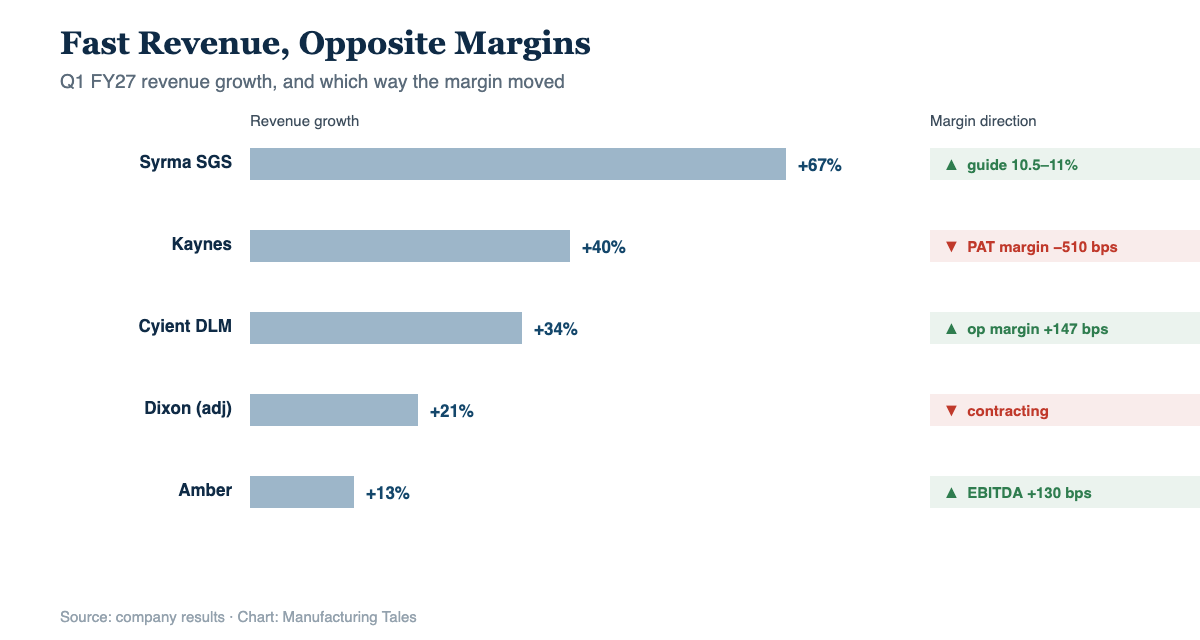
| Company | Revenue (YoY) | Net profit | Margin | What it tells you |
|---|---|---|---|---|
| Syrma SGS | +67% | >100% | FY27 EBITDA guide 10.5–11% | Exports 24%, ODM doubled |
| Kaynes | +40% | −24% | PAT margin 6.0% vs 11.1% | OSAT/PCB ramp costs |
| Dixon | +21% adj | Incl ₹519 cr one-off gain | Contracting | Net cash ₹226 cr vs ₹773 cr |
| Cyient DLM | +34% | +118% | Op 10.5%, +150 bps | Order book ₹2,600 cr |
| Amber | +13% | Adj +19% | EBITDA 8.7% vs 7.4% | Into PCBs, Oppo phones |
The table splits cleanly, and the split is the whole story. The firms climbing out of plain assembly, Cyient DLM with design-led manufacturing and Amber pushing into printed circuit boards, expanded their margins. The firm running hardest on scale, Kaynes, saw its PAT margin collapse from 11.1% to 6.0% as it absorbs the cost of ramping OSAT and PCB lines. And two of the headline profit figures are not what they look like: Dixon’s reported profit was inflated by a ₹519 crore fair-value gain on a stake, while Amber’s headline PAT fell 97% on a one-off ₹123 crore charge, even as its adjusted profit rose 19%.
Why Assembly Eats Cash
The reason margin is so scarce sits in what these companies do. Final-assembly EMS is structurally thin and hungry for working capital, which is why Dixon’s net cash fell to ₹226 crore from ₹773 crore in three months as inventories and receivables ballooned. Growth in assembly consumes cash faster than it produces profit. The entire equity thesis rests on climbing the chain into components, boards and design, and Amber’s move into PCBs and Syrma’s doubling of ODM sales are exactly that climb.
Why This Matters
The PLI-era story was that India could finally assemble electronics at scale. That phase is over, and it was never the prize. Assembly is the entry ticket; the value is in components and design, and Q1 FY27 was the quarter the market made that explicit, marking down headline revenue and rewarding backward integration, mix and cash conversion instead. The EMS names still standing in three years will be the ones spending now to climb, and swallowing the margin and cash pain it takes to get there.
That climb is precisely what the Electronics Component Manufacturing Scheme is trying to fund, and what the first OSAT plants are being built for. It is also the same margin question now facing India’s capital goods order books.