
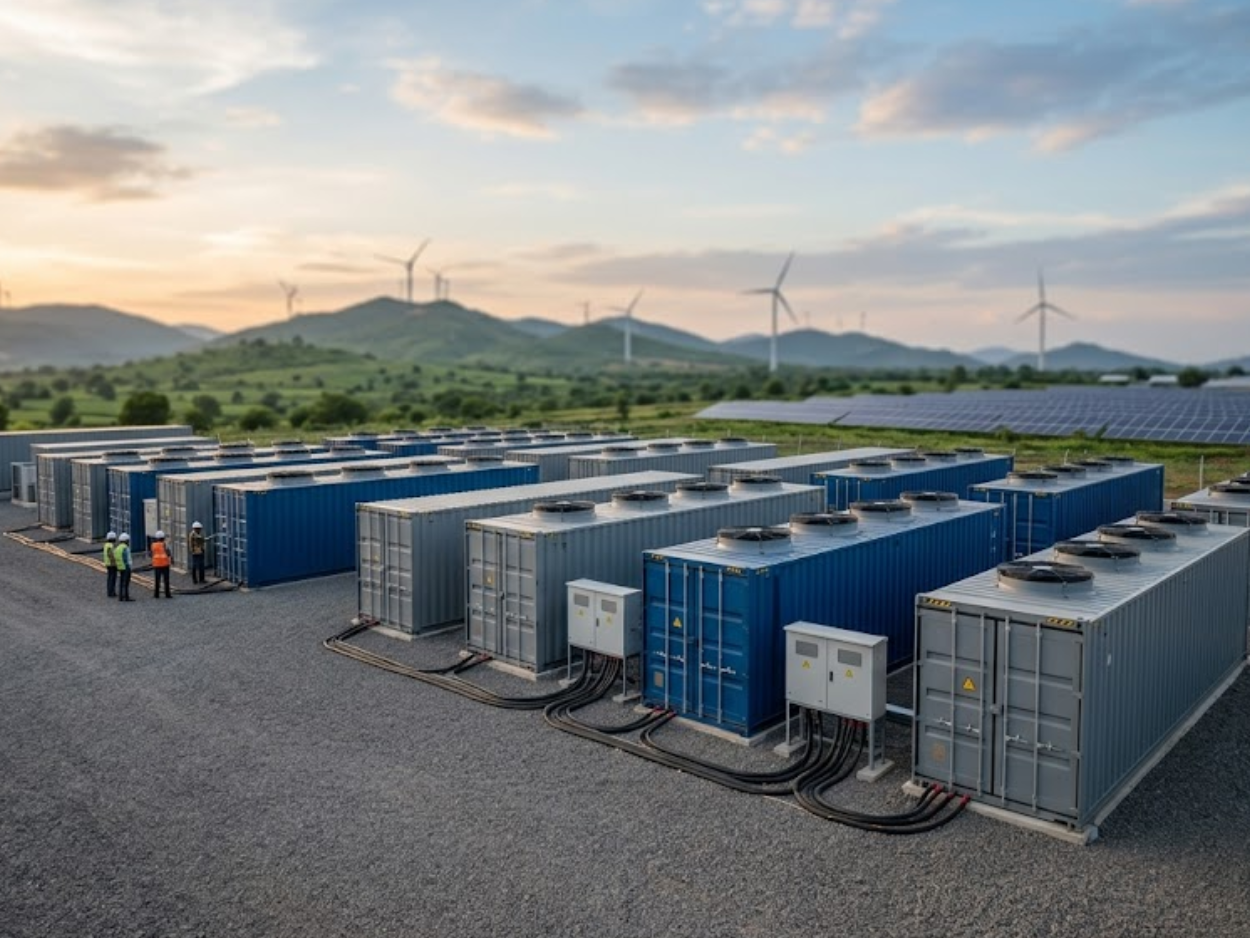
Pace Digitek BESS manufacturing has just doubled in scale. Pace Digitek has commissioned a new Battery Energy Storage System (BESS) manufacturing line through its subsidiary, Lineage Power Private Limited, doubling its installed capacity from 2.5 GWh to 5 GWh. On the surface, this reads like a routine corporate capacity update. Underneath it, though, is a signal worth paying closer attention to: India’s energy storage manufacturing base is shifting from early, single-line operations to genuine industrial scale, and that shift has consequences for a much wider set of manufacturers than the battery industry alone.
The Announcement
The expansion comes just about a year after Pace Digitek entered BESS manufacturing, and it’s part of a rapid, staged scale-up rather than a one-off jump. Chairman and Managing Director Venugopal Rao Maddisetty framed the new line as a continuation of the progress made over the past year in building an integrated BESS business, one that spans manufacturing, engineering, system integration, EPC execution, and long-term operations and maintenance.
The Expansion Beyond 5 GWh
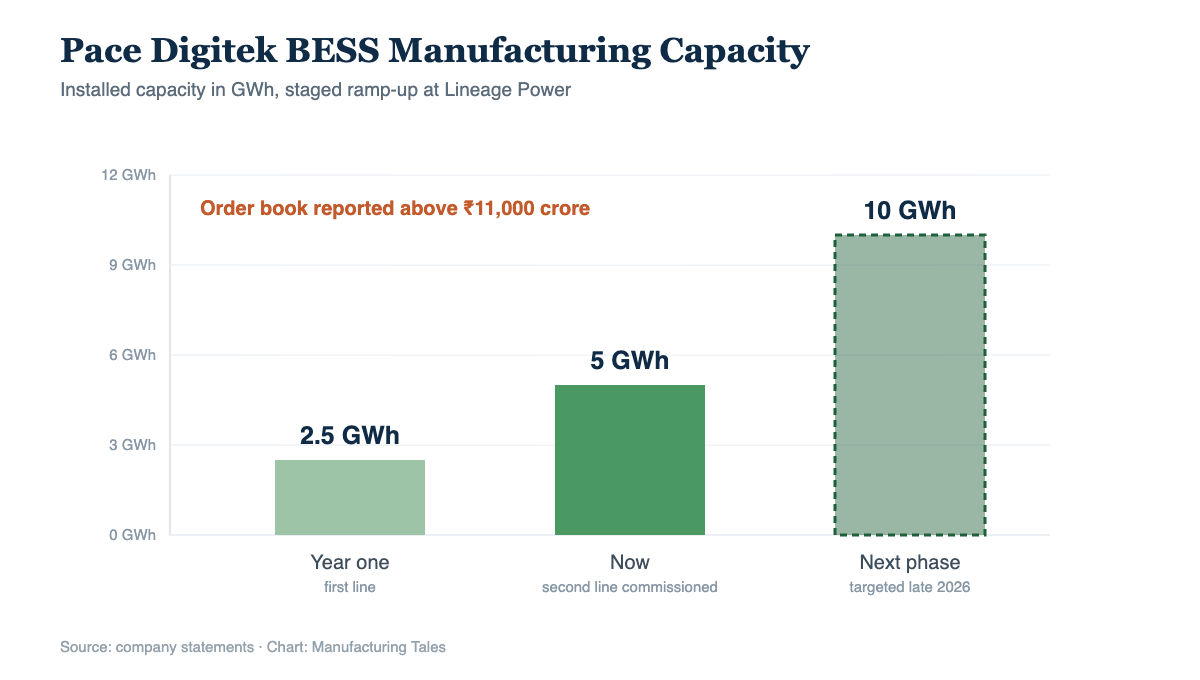
The company isn’t stopping at 5 GWh. It has already initiated the next phase of expansion, targeting a total manufacturing capacity of 10 GWh, with commissioning expected around September-end to mid-October this year. Equipment for the new line has reportedly been ordered and was expected to arrive by August, with infrastructure and facility preparation already largely complete. In parallel, Lineage Power is developing an in-house container fabrication facility, aimed at strengthening backward integration and giving the company tighter control over its supply chain.
The scale of ambition here is backed by numbers: an order book reportedly exceeding ₹11,000 crore, and BESS expected to account for more than half of the company’s revenue in the coming financial year. That’s a company betting heavily and publicly on India’s storage buildout.
Why Battery Storage Manufacturing Matters Right Now
To understand why this expansion matters beyond one company’s balance sheet, it helps to step back and look at where India’s power sector is headed.
Why Pace Digitek BESS Capacity Lands at the Right Moment
India is adding solar and wind capacity at a rapid pace, but renewable generation is inherently intermittent, solar drops off after sunset, wind varies by the hour. Battery Energy Storage Systems solve a structural problem in this transition: they store surplus renewable power when it’s generated and release it when it’s needed, smoothing out supply, stabilising the grid, and enabling round-the-clock clean power rather than power that’s only available when the sun is out or the wind is blowing.
As India’s renewable capacity additions accelerate, BESS stops being a nice-to-have and becomes a hard requirement for the grid to function reliably. That’s precisely why capacity expansions like this one are happening in rapid succession across the industry, not just at Pace Digitek.
The Ripple Effect
A battery storage manufacturing line doesn’t operate as an island, it sits at the centre of a fairly long and specialised supply chain, and scaling it pulls a wide range of other manufacturers along with it.
Who Gains Across the Supply Chain
Cell and battery pack suppliers are the most immediate beneficiaries. As BESS manufacturers scale production, demand for lithium-ion cells and assembled battery packs whether sourced domestically or through localisation partnerships grows in direct proportion. This is one of the more strategically important links in the chain, since India currently imports a large share of its battery cells, making domestic cell manufacturing an adjacent opportunity worth watching closely.
Power electronics manufacturers sit right alongside the batteries themselves. Every BESS installation needs power conversion systems (PCS), inverters, and energy management systems (EMS) to actually make stored energy usable on the grid. Indian companies capable of manufacturing or assembling these components stand to see rising order volumes as BESS deployment scales nationally.
Container and enclosure fabricators may be the least glamorous part of this story but one of the most consequential for MSMEs. Utility-scale BESS is typically deployed in standardised containers that need to be structurally sound, weatherproof, and fire-safe. Pace Digitek’s own move to build in-house container fabrication signals just how critical, and currently underdeveloped, this segment is in India. That gap is an opening for steel fabrication units, structural engineering firms, and specialised enclosure manufacturers to enter a fast-growing supply chain.
Thermal management and safety systems providers are increasingly essential as BESS deployments scale. Battery safety, especially thermal runaway prevention, has become a non-negotiable requirement for utility-scale storage. Companies specialising in cooling systems, fire suppression, and battery management electronics have a growing, safety-critical role to play here.
EPC contractors and system integrators benefit from the sheer volume of projects a scaled BESS manufacturer needs to execute. Pace Digitek’s own model spanning manufacturing through to EPC and long-term O&M hints at how tightly these functions are bundled together in practice, creating opportunities for independent EPC firms and integrators who can partner into this ecosystem rather than compete head-on with vertically integrated players.
Skilled technicians and engineers are arguably the least visible but most enduring beneficiaries. Scaling from 2.5 GWh to 5 GWh, and soon to 10 GWh, requires trained personnel across production, quality assurance, systems integration, and field deployment. This creates sustained demand for technical training in battery manufacturing, power electronics, and grid integration skills that, once built, remain valuable well beyond any single company’s expansion cycle.
Renewable energy developers and utilities, while not manufacturers themselves, are the demand side of this entire equation. As domestic BESS manufacturing capacity grows, developers get more reliable access to storage solutions without the long lead times and currency exposure that come with imports, a meaningful operational advantage as India’s renewable project pipeline keeps expanding.
A Pattern Worth Recognising
This is a familiar shape. Whether it’s defence manufacturing, semiconductor packaging, or now battery storage, the pattern repeats: a single company’s capacity announcement is rarely just about that company. It’s usually the visible tip of a much larger supply chain quietly forming underneath component suppliers upgrading their capabilities, fabricators entering new segments, training institutes adjusting their curricula, and MSMEs finding an entry point into a high-growth, technically demanding industry.
What This Signals for Indian Manufacturing
Battery energy storage, in particular, sits at an unusually convenient intersection of India’s industrial and energy policy priorities, it touches manufacturing localisation, renewable energy targets, and grid modernisation all at once. That makes it a sector worth watching not just for what one company builds, but for how many other companies get pulled into building alongside it.
The Bigger Picture
Pace Digitek doubling its BESS capacity to 5 GWh, with 10 GWh already in motion, will likely be remembered as a corporate milestone. But the more durable story is what it signals about India’s storage manufacturing base moving from nascent to industrial scale, and the wide band of cell suppliers, electronics manufacturers, fabricators, safety specialists, and skilled workers who will find real opportunity in the years it takes to get there.
The Bottom Line
The gigawatt-hour number is the headline. The supply chain forming around it is the story that keeps developing long after this announcement fades from the news cycle.