
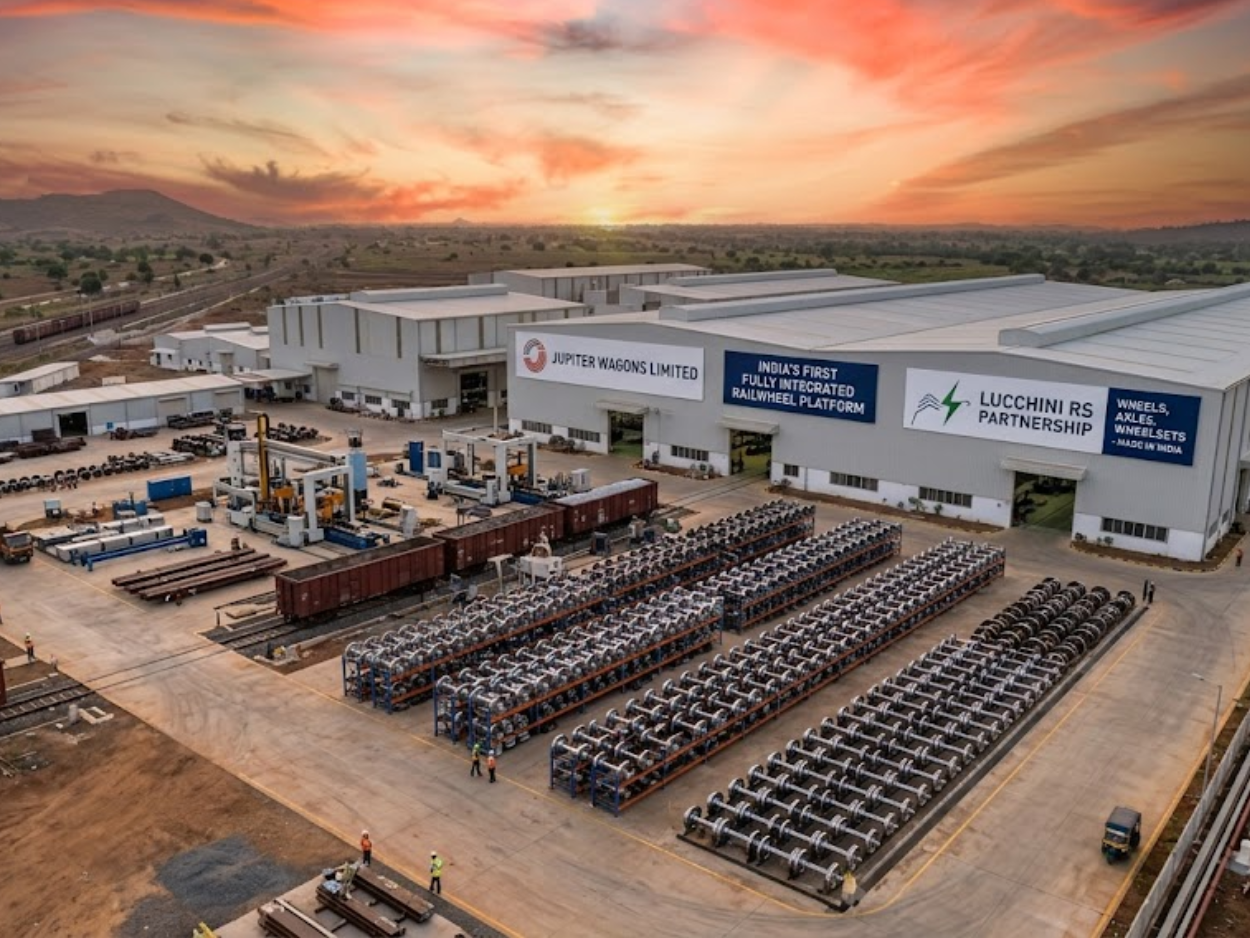
Jupiter Wagons has signed a strategic partnership with Italy’s Lucchini RS Holding to build what the company is calling India’s first fully integrated private-sector railwheel manufacturing platform, a single facility capable of producing railway wheels, axles and wheelsets across the entire value chain, from raw material to finished product. It’s a headline that sounds like a story about trains. It’s really a story about India closing a long-standing gap in a critical, high-precision segment of heavy manufacturing, and what that gap-closing means for the companies that sit around it.
The Deal
Under the binding agreement, Lucchini RS will acquire a 15% stake in Jupiter Tatravagonka Railwheel Factory Pvt Ltd (JTRWF), the joint venture entity running this business, while SIMEST S.p.A. an Italian government-backed development finance institution will pick up an additional 10%. Together, that 25% stake is valued at roughly €28 million (about ₹307 crore), backed by Italy’s Sistema Italia framework and coordinated through the Italian Ministry of Foreign Affairs.
The plan combines two existing pieces with one new one. JTRWF’s current facility at Chhatrapati Sambhajinagar, which already handles wheel machining and assembly, will be integrated with a new greenfield complex coming up in Odisha, one that will house forging, primary metallurgy and wheel manufacturing under a single roof. Once operational, this will be India’s only fully integrated private-sector platform for wheels, axles and wheelsets.
The timeline is fairly aggressive: axle production is expected to begin by the end of this year, wheel manufacturing by the third quarter of next year, and full-scale operations targeted for FY28. Jupiter Wagons is guiding for around ₹3,000 crore in annual revenue from this business by the end of FY28, at margins upward of 18%, with exports expected to make up 50–60% of that revenue, helped along by Lucchini’s global network and existing demand from European wagon maker Tatravagonka.
Why This Gap Mattered
India currently lacks deep domestic expertise in manufacturing wheelsets suited for high-speed and semi-high-speed rail, a technically demanding niche where Lucchini RS, a 170-year-old Italian company, is considered a global leader. As India’s railway modernisation programme accelerates high-speed corridors, semi-high-speed upgrades, expanding freight and metro networks, the country has largely had to rely on imports for this specific category of component.
That’s a meaningful strategic gap. Wheels and axles aren’t a peripheral railway component; they’re one of the most safety-critical, precision-engineered parts of any rolling stock, and building domestic capability here touches self-reliance goals as much as it does industrial ones.
The Ripple Effect
An integrated railwheel platform of this scale doesn’t function as a standalone plant, it anchors a whole cluster of upstream and downstream manufacturing activity, and that’s where the opportunity for India’s broader industrial base opens up.
Forging and metallurgy suppliers are the most direct beneficiaries. Building wheels, axles and wheelsets from raw material requires large-scale forging capacity and precision metallurgical processing, exactly the kind of heavy, high-tolerance work that Indian forging houses and steel processors have been steadily building capability in. A facility of this scale creates sustained, high-volume demand for exactly that expertise.
Steel and raw material producers sit just behind the forging stage. Railway wheelsets require specific steel grades engineered for fatigue resistance and load-bearing performance under constant stress. Domestic steel majors and specialty steel producers capable of meeting these metallurgical specifications have a clear opening to become long-term suppliers into this platform, rather than losing that value to imported semi-finished components.
Precision machining and component manufacturers come in downstream. Once forged, wheels and axles require exact machining, balancing and quality testing before they’re assembled into finished wheelsets. This is intricate, tolerance-heavy work, the kind that rewards Indian precision engineering firms willing to invest in the certifications and equipment needed to supply rail-grade manufacturing.
Testing, inspection and certification bodies become increasingly important as this platform scales toward export markets. Railway components destined for international customers typically require rigorous, internationally recognised testing and certification. That creates room for India’s testing infrastructure — and the specialised firms that operate it, to expand alongside the manufacturing base itself.
MSMEs in ancillary component supply stand to gain from proximity. Large integrated rail manufacturing hubs typically pull in a surrounding base of smaller suppliers for fixtures, tooling, fasteners, logistics, and packaging much the way large auto and defence manufacturing clusters have done elsewhere in India. The Odisha facility, in particular, could become an anchor for a regional industrial ecosystem that didn’t previously exist at this scale.
Skilled workforce and technical training providers see a longer-term but equally significant impact. Metallurgy, forging, precision machining and quality assurance for rail-grade components require specialised technical skills. Building this workforce locally rather than relying on imported expertise creates durable demand for vocational and technical training focused on heavy engineering and metallurgy, skills that outlast any single project.
Indian Railways and rolling stock manufacturers, while not part of the supply chain in the traditional sense, are the ultimate demand anchor. A reliable domestic source for high-speed-grade wheelsets reduces import dependency and lead times for India’s expanding rail modernisation programme — a strategic benefit that compounds as the network grows.
A Familiar Pattern, Again
This mirrors what’s playing out across India’s manufacturing landscape right now in defence, in semiconductors, in battery storage, and now in rail. A single flagship partnership becomes the visible headline, but the more consequential outcome is the base of forging houses, steel producers, precision machinists, testing labs and MSMEs that get pulled into building alongside it. Global technology partners like Lucchini RS aren’t just bringing capital, they’re bringing decades of process expertise that, once localised, tends to raise the bar for every supplier that plugs into the ecosystem around it.
The Bigger Picture
The Jupiter Wagons–Lucchini RS partnership will likely be remembered as the deal that gave India its first fully integrated railwheel manufacturing platform. But the more lasting impact is what it sets in motion around it, a domestic forging and metallurgy base built to rail-grade standards, a precision machining ecosystem with a genuine reason to invest in certification, and a workforce trained in a category of heavy engineering India has long depended on imports for.
The €28 million stake and the ₹3,000 crore revenue target will be the numbers everyone quotes. The supply chain quietly forming around the Odisha facility over the next few years is the story that will matter more.