

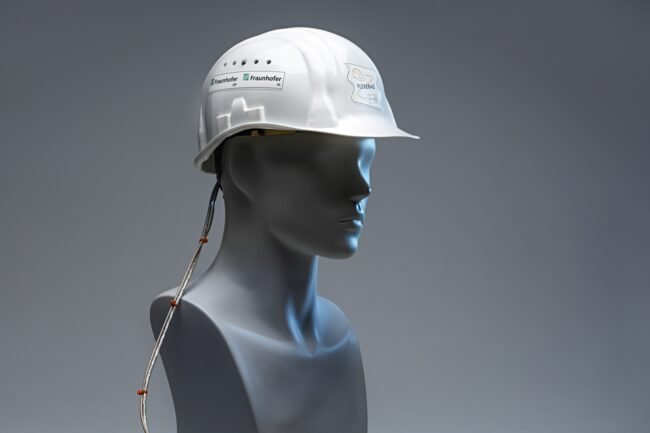
Fraunhofer researchers have developed a helmet with an integrated acceleration sensor for drivers of construction vehicles. The helmet sensor measures harmful vibrations that affect the body. A software analyzes the sensor signals and shows the stress on the affected person. This allows corresponding relief measures to be taken. A flexible piezo-electret film serves as the sensor. A demonstration model for the Flexeras project will be presented at the joint Fraunhofer booth at the Hannover Messe (April 22–26, 2024, Hall 2, Booth B24).
People who drive heavy construction machines are exposed to heavy vibrations almost continuously. Excavators, wheel loaders or bulldozers generate low-frequency vibrations that travel through the human body and can cause health problems over the long term, including impaired vision or damage to the spinal column and brain, for example.
Researchers at the Fraunhofer Institute for Structural Durability and System Reliability LBF in Darmstadt have developed a solution to this as part of their Flexeras project: A protective helmet with an integrated acceleration sensor registers the vibrations affecting the body and passes them via a transmitter to an external computer, where they are analyzed and visualized. This makes it possible to identify when stress limits have been reached for the person on the driver’s seat at any time. Accordingly, measures can be taken to relieve the excavator driver, such as better damping of the seat — or ensuring that breaks are taken at the right time.
Björn Seipel, an expert in electromechanics and automation at Fraunhofer LBF, says: “The whole-body vibrations to which construction machine drivers are exposed reach acceleration values of 0.2 m/s² to 1.5 m/s² on average; peak values can be considerably higher. Our helmet sensor makes it easy to precisely measure the vibration load in everyday operations. Health protection can be considerably improved on this basis.”
In addition to Fraunhofer LBF, the Fraunhofer Institute for Integrated Circuits IIS in Erlangen was also involved as a project partner. The system will be presented as a helmet demonstration model at the Hannover Messe 2024 (April 22–26, 2024) at the joint Fraunhofer booth (Hall 2, Booth B24).
Piezo-electret film as an acceleration sensor
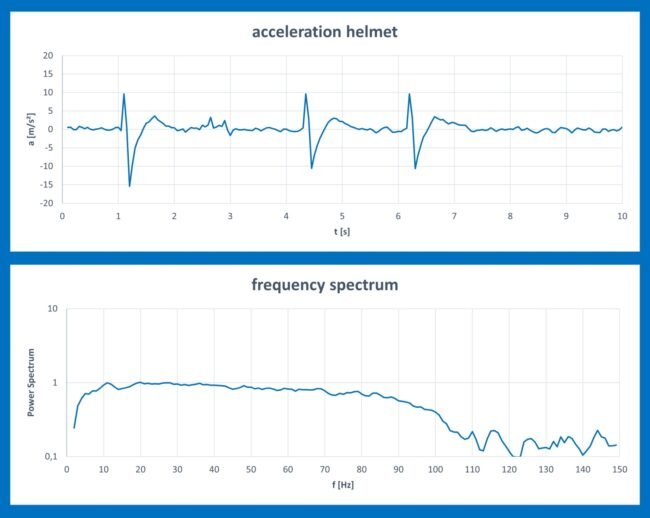
At the core of this technology is a piezo-electret transducer in the form of an inconspicuous, flexible polypropylene film that serves as a sensor. The film is integrated inside the helmet on top of the head in a fastening strap. Vibrations that emanate from the construction vehicle and travel through the body hit the film as acceleration forces and deform it. The degree of deformation determines the piezo-electret film voltage, which is transmitted to the electronic module as a signal. In the electronic module, the signals are processed, transferred to a transmitter unit fastened to the body, and sent to a computer via a wireless connection. The software installed there records the signals and shows the vibrations from selected frequency ranges in real time. “Frequencies between 4 and 6 Hz are hazardous to the spinal column, for example, and the head and eyes are particularly at risk in the range between 20 and 30 Hz. The software can be configured so that it emits a warning when certain limits are reached, for example,” explains Fraunhofer expert Denis Becker of the Experimental Analysis and Electromechanics department.
To analyze the data, experts at Fraunhofer IIS contributed their expertise in the field of data analysis for medical sensor systems. Data analysis also allows the Fraunhofer experts to determine in which of the relevant frequency ranges the vibrations are particularly strong and to create a kind of vibration profile for each construction vehicle.
Vibration tests when designing new construction vehicles
The new Fraunhofer technology creates the basis for effectively protecting people who work with excavators, tractors or other construction machines. For example, seats can be equipped with additional damping elements, or drivers are reminded to take a break when the software detects that a stress limit has been reached. In the future, the receiver unit and the software could also be integrated in the on-board electronics of construction vehicles. “When new construction vehicles are developed, this technology helps to measure the level of vibrations and then reduce them through targeted measures, even in early prototypes,” Becker adds.
With Flexeras, Fraunhofer LBF has contributed its many years of expertise in the area of transducer systems. The experts develop, among other things, concepts and ideas for transferring existing transducer systems such as piezo-electret films to new applications.
Help for employers and employers’ liability associations
The industry has great interest in this Fraunhofer technology. After all, employees who become ill after working too long on a construction vehicle are not only a problem for employers with regard to their duty of care but also to costs. The helmet sensor assists medical associations and employers’ liability associations with a data-based and differentiated evaluation of the actual stress on workers. Further applications are conceivable. “Our technology is generally suitable for people in all occupational groups that are frequently exposed to high biomechanical stresses,” explains Seipel.
Visitors to the Hannover Messe 2024 can see the solution live with a demonstration model at the joint Fraunhofer booth (Hall 2, Booth B24).